A snap shot of events during the year.
A snap shot of events during the year.
Restoring the Soul – A meditation by Sally Welch: read by Mark Wood
Righteousness and Peace – A meditation on Isaiah 32
We are seeing a huge increase in the number of people falling sick with COVID-19. We must distance ourselves from one another and prevent the spread of infection in order to save lives. In line with Government regulation, therefore, all church buildings in the Church of England are now closed.
Our worship of God and our care for each other continue but cannot be done in this building. Regular aids to prayer are posted on our Facebook page (Wilton Parish Church) and further resources are available on the Church of England Website (see “Links” on this site)
God is our refuge and strength, a very present help in time of trouble. Therefore we will not fear. Psalm 46 v 1- 2
Our church buildings are closed, but the Church is alive in prayer:
Keep us, good Lord,
under the shelter of your mercy
in this time of uncertainty and distress.
Sustain and support the anxious and fearful,
and lift up all who are brought low
that we may rejoice in your comfort
knowing that nothing
can separate us from your love
in Christ Jesus our Lord.
Amen.
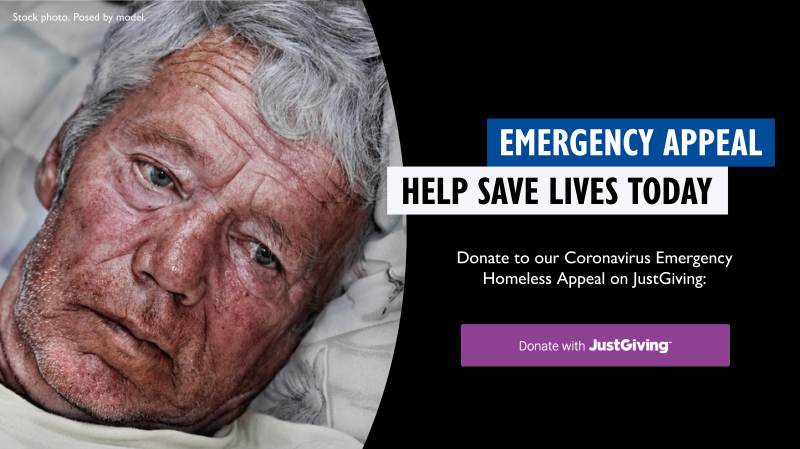
As you know, here at Alabaré we are working with very vulnerable people. The homeless people we support are extremely vulnerable to Coronavirus; 75% of our homeless clients have underlying health issues and many have no one else to turn to.
Our dedicated teams are on the front line working around the clock to keep our clients safe. We are getting rough sleepers into our homes where we can support them if they fall ill, and helping vulnerable and scared people to self-isolate, making sure they have a safe home, food and medication in this time of urgent need.
‘Rough sleepers do not have access to the soap and water we are all using to help protect ourselves. They do not have the means to self-isolate. The vast majority are more susceptible to illness and many have complex underlying health problems. If the virus does spread, homeless people could be amongst the first to die.’
Sue, Alabaré Homeless Service Manager
Coronavirus is already putting huge strains on Alabaré financially. Our charity’s services are facing unprecedented challenges and are putting emergency procedures into place. Our fund-raising events over the next 6 months have all had to be postponed and we are facing an immediate loss of at least £100,000 at a time when we desperately need that money to help save lives. If we are unable to raise this money quickly, this virus threatens our charity’s survival.
You can access the online appeal through our website (link below), by cheque to ‘Alabaré Christian Care & Support’ or I would be delighted to send you our bank details if you are able to make a direct transfer.
https://www.alabare.co.uk/news/coronavirus-emergency-appeal
Coronavirus – COVID 19 – 23 March 2020
Following Government advice, the Archbishops of Canterbury and York have suspended all public worship. This means that no normal Sunday services, or midweek Eucharists can take place and the forthcoming Feast of Easter will not be celebrated in the normal way.
This is a difficult situation for many of us, but the seriousness of the threat to public health, and especially to some of the more vulnerable members of our community, mean that drastic measures are right and necessary.
To help us to maintain a sense of unity, as well as to assist our private devotions, a number of resources are being made available on line: initially there are links on the church’s Facebook page (Wilton Parish Church). it is hoped to add further sites and resources in the next few days.
Church-members who do not have access to the internet can have paper copies of meditations or recordings on CD.
Weddings, Baptisms and Funerals are permitted, but under very restricted conditions. Please check the Church of England website for further details.
http://www.churchofengland.org/more/media-centre/coronavirus-covid-19-guidance-churches
Sermon preached on 15 December 2019 – Advent 3
Readings Isaiah 35:1 – 10; James 5: 7 -10 and Matthew 11: 2 – 11
Bathed in the Autumnal sunshine of the October half-term, a group of us cleared a huge amount of greenery from our church car park – almost 2 skips worth! And as we hacked away, we suddenly came across a coil of chicken-wire – obviously put there to protect something.
After further investigation, and more clearing, someone with a longer memory of Wilton than me said:
“Ah, that’s the millennium yew!”
And indeed, there was – and is – a dark green yew tree not very tall, having been comprehensively smothered, for several years, but very definitely alive!
At the time, I’d assumed this was some quirky Wilton tradition – a wooden millennium cross erected in the old churchyard, a new yew planted in this one.
But then, yesterday, I heard a tribute to the late David Bellamy, in which it mentioned “Project 2000” – an initiative inspired by him, which encouraged churches up and down the country to plant a Yew tree to mark the new millennium. So that, presumably, explains why there is a millennium yew in our churchyard, which hasn’t figured that much in our collective consciousness!
For the benefit of those who don’t know who I’m talking about – David Bellamy was a TV personality in the 1970s, 80s and 90s – and a trailblazer for ecological conservation long before it became the live issue it is today.
His particular interest was biodiversity – with a concern that we didn’t lose any of the species of our natural countryside. And he surprised many people, in later life, by saying that he didn’t think much about global warming – something regarded today as a primary driver for loss of species.
And it’s a sign, perhaps, of how things have moved on – that in the same week that he died, Time magazine named Greta Thunberg as it’s “person of the year.”
A new generation has produced a different ecological champion, with a very different outlook – although the fundamental aim of conserving the natural world, remains the same.
She is heralded as something of a prophet – and like all prophets before her – her words cause sharp and polarised reactions, from those who hang on her every word to those who write her off as an irritating upstart.
Such prophetic voices are not only hostage to developments, over time, in our collective understanding, but also to the popular mood of the moment.
And that can change very quickly.
Spot light on John the Baptist. It always seems odd, at this time of year, that he gets two bites at the cherry – featuring in last week’s gospel reading and again today. But note the difference – last Sunday he was flavour of the month – the crowds flocking to him for baptisms, even when he was seriously rude to them
Now he’s in prison, awaiting his grisly fate – his moment of glory has past.
And yet, in today’s reading, Jesus seems to be assuring him that his legacy is already secure – that Jesus himself IS the one John had been waiting for, and that John can now safely hand on his life’s work to Jesus.
John himself had always been clear that he was not meant to be centre stage – his role was to prepare the way for one who is greater than him. Jesus, in turn, pays warm tribute to John – “among those born of women no-one has arisen greater than John the Baptist”.
And yet – still, he asserts that John is the messenger, not the message: pointing to the kingdom but not yet “of” the kingdom.
Every prophet, it seems, plays his or her part in the greater transformation of the world by disturbing the consciences of men and women of their own time, inspiring them to look further and to seek the kingdom of God – but each is limited by the knowledge and culture of their own time.
Perhaps, then, our Advent our readings encourage us to acknowledge the legacy of John – and all those who’ve proclaimed the kingdom of God in earlier ages – AND, at the same time, to look out for the signs that God’s kingdom is already breaking into and transforming our world, and to play our part in bringing about that transformation:
to look out for the signs that Christ IS present in our time and in this place, to allow ourselves to be transformed by his message of redeeming love;
and to encourage the next generation to grasp that message and to interpret it for the world of tomorrow.
Sermon preached on 17 November 2019
Readings Isaiah 65: 17-25 & Luke 21: 5 – 19
Part of my Saturday routine involves nursing my brain into consciousness to the strains of Radio 4’s “The Curious cases of Rutherford and Fry” – a 15 minute programme in which Doctors Rutherford and Fry investigate scientific mysteries sent in by listeners.
Yesterday’s offering was a little unusual in that the listener in question was the comedian and presenter Stephen Fry – so it became the curious case of Rutherford, Fry and Fry.
What was troubling him was his own prosopagnosia – or “face blindness”. Like a surprising number of people, it seems, Stephen Fry, has great difficulty remembering people’s faces – and therefore recognising them.
He may well know the names and personalities of the director and every single cameraman while on set – filming some production or other – only to find himself standing in the canteen queue, later, and asking one of those same people what they do for a living. All very embarrassing.
And we heard the case of the sheep farmer, who could identify every single animal in his large flock, but couldn’t recognise the members of his own family. And you can imagine how they felt about that!
Then there was the school girl who relied on another person’s distinctive manner of dress to help her work out who they are – but who found school something of a nightmare, because all the students wore the same uniform! So, no visual clues to rely on.
And what the two radio sleuths discovered is that, although some cases of face blindness are caused by an accident in later childhood or adulthood, in the vast majority of cases it’s a lifelong affliction.
Most babies learn very quickly to recognise a small group of people – just as other species might learn to recognise the distinctive sound of their parents’ cries, so they can identify each other within the group –
And prosopagnosia, “face blindness”, is a failure of that survival mechanism to kick in.
For the majority of us, however, that instinct remains with us – we learn to see the things that are important – not only for our survival but also as part of the human brain’s never – ending search for meaning. We pick out the things that interest us, or reinforce our own way of viewing the world – which others may not.
As Dr Rutherford commented, the stories we hear of someone finding the face of Jesus on a piece of toast, or the image of Mother Teresa in a root vegetable, always feature people who are already inclined towards religious belief – we recognise what we have learned to see.
A different example of the search for meaning popped up, out of the blue, at last Saturday’s concert, here. Afterwards, I was approached by a member of the audience, who regards himself as a classical scholar, and who was puzzled by what is painted up above the choir.
There, below the cross of Jesus, are the two words “Salus mundi”. And while there’s no problem with mundi (world) – he didn’t recognise the word salus.
And while many of us who’ve sung in church choirs will have some across the phrase “Salvator mundi” – O Saviour of the world – this phrase, salus mundi is not so common.
So, I thanked him for my homework and said I’d look it up. And I discovered, among other things, that it is the motto for the state of Missouri, in the USA – where it is translated as “the welfare of the world” and that it appears elsewhere to mean “the salvation of the world”, the “healing of the world”.
Through the Cross of Christ we are meant to recognise the saving power of God – to anchor us in present difficulties and to point us to the new order of things that God is creating for us.
Like the old Sunday School joke, the suggestion painted here is that Jesus really is the answer to every question!
Yet, Jesus himself cautions that the answers we seek may not be that clear cut, and not that easy to recognise.
When he predicts the destruction of the Jerusalem Temple – the disciples want to know when and how this will happen. And at this stage of the Gospel, as tensions rise, there are many others who are asking similar questions – trying to force events into some kind of logical and religious pattern that they already know.
But Jesus simply carries on being himself –
doing exactly what he’s always done –
leaving everyone else to wait and see.
And it’s clear from what follows that, though Jesus may be the answer to our problems, he does not offer his followers immunity from hardship, from confusion, from disagreement – but the assurance that , by faith and faithful perseverance, we will come through and out the other side; seeing more clearly what it was all about.
“By endurance you will gain your souls”, he says.
In similar vein, our reading from Isaiah sets before us a vision of transformation – so powerful that what has been simply ceases to matter – a transformation based on a proper relationship with God; not just of individual souls,
but of the cosmos – all things in balance and true harmony with God’s will.
Again, that relationship depends on our learning to recognise the signs of what God is doing – even in the uncertainties of our own lives, and in the messiness of the world around us.
As we head towards Advent, then, perhaps both these readings encourage us to resist the temptation to try and nail down every detail of our lives – what we will do, when and how we will do it – and instead to try to attune ourselves to recognise the signs God gives us:
to see the face of Christ, perhaps not on a piece of toast, but in the face of other people;
in the things that they do;
in the richness of life itself.
And from there to respond and be transformed ourselves by what we see.
Two weeks ago, at All Saints – we ended our Eucharist with a sea of candles – each saint bearing their own light as a reminder that each of us has within us a smaller reflection of God’s own light – which is there not only to guide ourselves, but one another.
Sometimes we may struggle to see that in another person – as if peering at it through fog, as we really don’t get where they’re coming from; or we may experience someone else’s holiness as a rather severe and harsh spotlight on our own inadequacies and failings, leaving us feeling awkward and ashamed; and sometimes we may experience that same light as the gentle, comforting glow of a fellow pilgrim walking the same path with us.
Advent, I think, should bring all of those things – the path ahead being neither too safe nor predictable, and yet surrounded by signs of hope.
Somehow we need to remain alert and yet patient – drawn on by the vision Christ sets before us, but not so anxious to get there that we miss the vital signposts along the way.
Jesus bids his friends “wait and see” – for us, then, Advent is a time to make sure that we do learn to see, and not just wait.
 Wilton Parish
You must be logged in to post a comment.