Problematic prose, a prig, a prelate and a people’s princess!

Sermon preached on 3rd September 2017

Readings: Romans 12: 9 – end ;  Matthew 16: 21 – end 

Very often, at this time of year, I’ve reported back with my allegedly profound thoughts, – having taken some time off and ploughed through a whole stack of books.
This year I’ve been rather less successful – on both counts – and during these past few days of summer holidays, I’ve resorted to the television for relaxation instead: Roald Dahl would not have been impressed!

And yet – there was food for thought – even amidst that unplanned viewing. Two programmes in particular came to mind as I pondered today’s readings.

I’ll come to them in a moment but first, just to reflect that both readings are pretty familiar to us – every Lent we sing “Take up thy Cross” – and the sentiments of the first reading are echoed strongly in the hymn we’ll sing shortly, “When I needed a neighbour”.

Both readings also have a “catch” – one phrase that suddenly jars and leaves us scrabbling to make sense of it.

“Let love be genuine”, our first reading begins positively – and then goes on to details what that means.
The “problem phrase” comes at the end where we’re encouraged to help our enemies because “by doing this you will heap burning coals upon their head”.

That seems a rather odd reason for doing something good – is Paul saying “be kind to someone who doesn’t like you because, in the end, you’ll make it worse for them”?
That doesn’t quite seem to fit with the rest of the passage – and Paul has in fact borrowed that verse from Proverbs – but he’s clearly included it for a reason.

Perhaps this is just a slightly strange figure of speech – meaning that, by showing kindness to an enemy, we confound their way of being – that we do in fact “overcome evil with good”. Or maybe that’s just what I hope it means!

Cue programme one – a documentary marking the 20th anniversary of the death of Princess Diana.
On Thursday evening, as I waited in vain for one of our cats to come in from the garden, I found myself sucked into an hour long reflection on the extraordinary scenes that surrounded Diana’s funeral – so many people, from all walks of life, weeping openly in what we were told was a very un-British display of emotion.
And it’s the reason for that response – the reason why so many different kinds of people felt drawn to show their respects – that I think might be relevant here.

Very many of those people had, of course, never been anywhere near Princess Diana – had no real idea what she was like in person.

Some of those people who wept for her, would probably have been pretty hostile to anyone else who’d enjoyed the kind of wealth into which she was born. The “class wars” of the 80s were still not that far behind us.

And yet, by the time of her death, there were very few people who dared to speak against the People’s Princess.

I suspect that one of the reasons why so many people did feel drawn to her – did feel that they knew here – is that we’d been used to seeing images of her, our beautiful young princess, spending time with those whose were less than beautiful – embracing those disfigured and isolated by illness, cradling malnourished children,
loving the unloved.
It’s very hard to dislike someone we’ve seen expressing such love and acceptance of others – whatever their own background. Perhaps that is why Diana drew such large and varied crowds at her funeral.

And perhaps that’s what lies behind Paul’s words – and the burning coals. Perhaps the best way to deal with hatred or division is to show such kindness to those who hate us – that we simply make it impossible for them to go on thinking and behaving in that way.

Onto our Gospel then and, for me, the snag here is that paradoxical phrase “those who want to save their life will lose it, and those who lose their life for my sake will find it”. However we interpret those words, losing our life for Christ’s sake doesn’t sound a very inviting prospect.

Cue second TV experience – a rather longer viewing experience from even longer ago.

Back in 1993 Anthony Hopkins starred in a film called “The Remains of the Day” – appearing as “Stevens”, a very proud and devoted butler in a large Country House during the 1930s.
Stevens is definitely NOT prone to any un-British displays of emotion!

He is completely devoted to his employers.
His role within the household IS his life.

Even when he begins to suspect that his Lordship is welcoming some rather unsavoury guests, he will not utter or hear a bad word spoken against him.

Stevens’ life is based on duty and service – and that’s all there is to it. He is so devoted to serving others that he simply doesn’t HAVE a life of his own – and as the final scene fades, with an aging Stevens gazing out into the grey skies of a rather changed, post-war England, we’re left with a strong sense that this was a wasted life – a man devoted to a world that has gone, a man whom life has passed by.

Fortunately, Stevens is only a fictional character – but one with the power to move us, and caution us, about getting sucked into artificial systems and other people’s demands.
Surely that is NOT the kind of self-sacrifice that Jesus has in mind, when he spoke of “losing our lives”?
As it happens, I was rescued from my dark ponderings by the Radio – and another, very real, voice from the past.

A short clip was played, on Friday morning, of a recording of the late Cardinal Cormac Murphy O’Connor, who has just died. And I was struck instantly both by how familiar that voice sounded AND the fact that I’d entirely forgotten about him.

He had the rather difficult task of succeeding Cardinal Basil Hume – one of those rare people who just seemed to exude some kind of “personal holiness”. And, like Diana, Basil Hume was well connected – both by family ties and through the generations of public school boys he taught at Ampleforth.

Cormac Murphy-O’Connor was none of those things – and just seemed so completely and utterly different.
He was a very large man who somehow still managed to fade into the background – never seeking the lime-light for himself.

When he needed to speak out he did – I can remember him very ably deflating Richard Dawkins when he was at his most provocative and anti-Christian.
For the most part, however, Cardinal Murphy-O’Connor was content just to be there in the background – dependable, faithful, gentle presence – a committed servant of the Church, but very definitely still himself: a very human Archbishop.

And perhaps that’s a better model for us than the fictional Stevens – a better response to Jesus’ call to service.

As a Church we are called to provide that same, dependable, loving presence for all our neighbours – neither seeking publicity or glory for ourselves, nor allowing ourselves to be worn out by unthinking drudgery.

As individual Christians, we are called to give our lives to the service of others, but not to forget who we really are.
That call, it seems to me, is not so much a call to sacrifice our own identity, but our selfish pride – to live in such a way that we can both be fully ourselves and engage fully with one another.

To “give our lives” in that way is to gain more than we lose –
as we discover what it really means to live in communion with God and our neighbour.
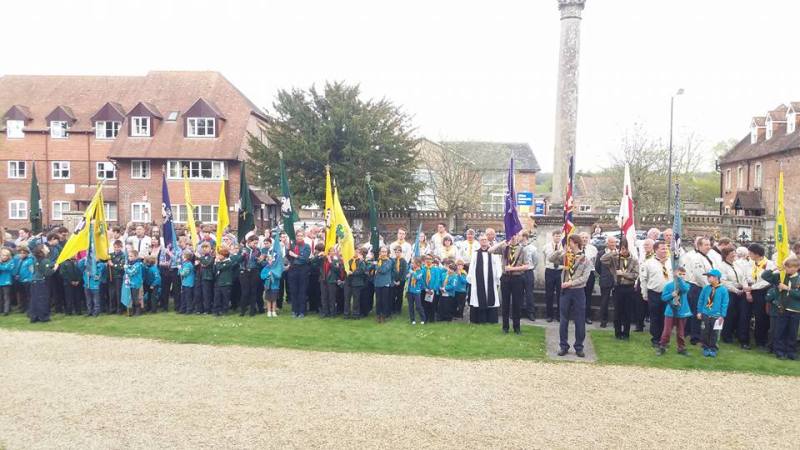
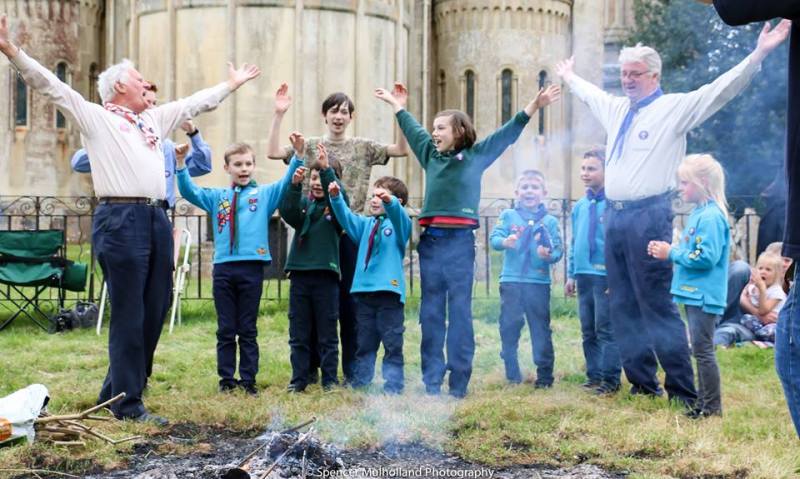
 

St George, good neighbours and campfires!

Address given at the District Scouts’s St’ George’s Day Service, 23rd April 2017

Today, St. George’s Day, we celebrate and feel proud of – our country and our achievements – and of the Scouts and our achievements: We’re celebrating who we are – and how proud we are of all the people like us.

And I for one think that is a good thing to do – we are helping each other to feel good about ourselves and recognising that we need each other to be part of something bigger than ourselves – our Scouts group and our country.
But it feels a bit strange to me, this year, to be marking St. George’s Day – following the Brexit vote – and just a few weeks after our government started the process of taking our country out of the European Union.

Here we are celebrating our national day as normal, but also having to work out again what “being British” actually means – what being English actually means –
and how our country now fits in with the rest of the world.
And I think we’ll need to be careful to spot the difference – between people who are just proud of their own country – and those who actually want to separate themselves off from everyone else.

In our own minds, we need to try not to divide the world into “people who are like us” and people who are not like us.

In the story of the Good Samaritan, Jesus teaches us that “our neighbour” is anyone, and everyone, who needs our help.

No matter what we look like or sound like, no matter what religion we follow or what language we speak – to Jesus we are all neighbours.

So, yes, we can and should be proud of who we are, but we also need to be generous in the way we look at other people “outside” our own country AND in the way we treat the “strangers” who are here with us – people who’ve come from another country and made their home here.

These are our neighbours, Jesus says, just as the Samaritan was a good neighbour to the Jewish man in our story.

I hope that all of you are proud of whichever Scouts group you belong to – whether Beavers, Cubs, Scouts, or Explorers, Sea Scouts, Air Scouts or anyone else I’ve forgotten!

But I hope that you also feel proud when you join together with other groups from around the District – for occasions like this.
It’s good to really know the people in our own group – but it’s also good to know that there’s a much bigger group of people all doing the same kind of things that we do, and to know that we belong to them as well.

And if you’re ever lucky enough to get to one of the bigger meetings – perhaps with Scouts from other countries – you’ll get an even better sense of what it means to be part of the Scouting movement – which spreads around the world.
There are Scouts who wear uniforms very different from any of yours, there are Scouts whose language and culture would seem very strange to us – and yet, they too are proud to be Scouts. And it’s good for all of us to remember and celebrate just how big and varied that movement really is.

Whether you are part of 1st Wilton, Old Sarum, 1st Boscombe Down, Tisbury, Bourne Valley, Fisherton Explorers, or somewhere else entirely – you are first of all a Scout – part of the worldwide Scouting Movement.

No matter which country you come from, you are first of all a child of God – part of the one human family.

So, be proud of who you are and of those people closest to you – God has made you special and unique – but don’t let that pride turn you against everyone else.

It’s only by working together –
with people like us and with those who are different –
that we discover just how good we really can be and just how much good we can really achieve.scouts 17b

scouts17xxviii

Promises, promises!

Sermon preached on 5th March 2017

Readings: Genesis 2: 15-17; 3: 1-7  Matthew 4: 1 – 11

Yesterday, I stumbled across a compilation of TV adverts from the 1970s and 80s – and it’s surprising how many are still lodged somewhere in the memory, even though I may have not have THOUGHT about them for a long time.

There was the glamorous Nanette Newman, with her “hand that do dishes”, advertising Fairy washing-up liquid – alongside an impossibly long and shiny table covered in impossibly white and shiny plates and cups and dishes.

There were reminders of the much-loved and highly inventive adverts for Hamlet cigars: always accompanied by Bach’s “Air on a G sting”, various characters endured some embarrassing mishap or other – then lit up a cigar and smiled through it all anyway.

One which I didn’t remember was an early one for McDonalds – which seemed just to list the various kinds of burger which we may or may not wish to inflict on our digestive systems: a reminder perhaps that the Fast Food chains that now surround us are in fact a relatively recent addition to our culture.
One thing that became clear surprisingly quickly is the fact that many of the adverts are actually about something very different from the actual product they are promoting: they “work” by sowing the seeds of “dissatisfaction with our lot” and offering the illusion of something different – “buy this and your life will be a whole lot better”.

I remembered very clearly an early advert for the Breakfast Cereal ”Ready Brek” – with the strap line “Central heating for kids”. Since, in the 70s, I was still at primary School and having to wear short trousers – in winter as well as summer – I do remember pestering my parents to buy some, on the assumption that I WOULD feel warmer on the way to school and in the playground once I got there. I quickly discovered that it didn’t work!

Barclaycard filmed Alan Wicker – in various exotic locations – clearly implying that with this credit card the world could be our oyster…. provided we can pay the bills afterwards.

Meanwhile, there was a common sub-plot to adverts for anything from Old Spice after-shave to Starbrite toothpaste, from Clearasil skin cleanser to the Maltesers which probably gave us spots in the first place: all of those things, and many more, would, it seems, guarantee to get us noticed by the opposite sex.

And harmony between the generations could apparently be bought either in the shape of a finger of fudge (“just enough to give your kids a treat” or, more recently, a packet of Worther’s originals.

I suppose, to some degree, we accept that this is the way advertising works – with so many things on offer, advertisers have to do something to grab our attention.
But I’m not sure that it IS only in the adverts that this kind of psychology is used.
The same sense of dissatisfaction – of yearning for something better – seems to have found its way into the mainstream TV schedule: “Grand Designs”, “Building Dream Homes” and several imitations promote the idea that you can buy or build your way to lasting happiness: your “forever home” is just a few months’ graft and a large overdraft away.
Programmes such as “Escape to the Country” and “Home or Abroad” are based on the idea that you can simply up sticks and start again somewhere else.

What is offered in either case is not just a shiny new home, or a change of scene, but the vision of a new life – a new “you” – freed from the problems of our daily reality, rather like being on holiday for ever.

That vision is, of course, just an illusion – no more real than the side benefits of Ready Brek or Clearasil.

And yet these programmes are popular – because they do tap into a real yearning – a natural desire to strive for more. The fact that one of the 10 Commandments instructs us not to “covet” our neighbour’s possessions – suggests that this instinct is not a new one.

We find it hard to be satisfied with what we have – and we find it equally hard to be satisfied with who we are.
And so we’re taken in very willingly, by the promise of something more, no matter how illusory that promise may actually be.
That very human instinct lies behind both of our bible readings this morning.

Adam and Eve have been created in God’s image – they have all of creation at their disposal – and yet the serpent persuades them that they can be even MORE like God – if only they will eat of the forbidden fruit. This is the one “product” they need to guarantee REAL happiness: but I the event that promise turns out to be false.

And as Jesus is tested in the wilderness, the tempter employs a certain logic: obviously Jesus is going to eat again some day, so why not just get on now and make himself some bread? Or, since the Father has already told him “You are my beloved Son”, surely it’s not too much to ask him to show that love – by sending angels to save him from a sticky end if he jumps? Finally, comes the real test – the promise of absolute power. Again, that is an illusion – as that power is not his to give away.
What’s on offer here is the “forever home” type of promise – a vision of lasting happiness that neatly forgets reality – the things that will happen beyond our control and force us to adapt, whether we like it or not.
Jesus’ 40 days in the wilderness – our 40 days of Lent – give space to challenge and overcome those deceptions: to recognise the difference between the promises of God and the illusions that we, or others, construct for ourselves.

Jesus heads out into the wilderness to think about who he is and what he has to do – and we now face the same challenge – to learn who we are meant to be – to learn to be true to ourselves – to learn to be satisfied with ourselves.

That’s not an argument for having no ambition – for simply being content not to achieve much in life – in fact it may be the opposite. Discovering who God calls us to be – recognising the unique gifts of those around us – may in fact drive us to challenge the status quo – to challenge any people or systems which seem to prevent people from living fully human lives.
The first step, however, is that act of recognition –– that we don’t need to and cannot, in fact, buy ourselves into something new or greater – that we are already “God-like” – made in God’s image.
This afternoon and tomorrow evening – 13 parishioners will begin preparations for Confirmation. They come in various shapes and sizes – 8 of them under 16 years of age, and 5 of them a little older!
That’s really encouraging, I think – it’s certainly the largest group I’ve ever seen here and the first time in many years that we’ve been able to have a Confirmation service here in our own church. And so I hope we will ALL be excited for them and strengthened by the promise of what they bring among us.

For all of those candidates, then, this Lent will be a particularly important one – in discovering who they are and who God calls them to be, within the fellowship of his holy people.

And so I’d ask you to pray for them all – as they begin to explore – and for me, please, as I try to guide them along the way.

Throughout these 40 days may we also pray for ourselves, and for each other, that we can stop trying to be more than ourselves – that we can learn to love ourselves as we are – because we are already made in the image and likeness of the One who loved us first, and loves us still.

Cross Country walking?

Sermon preached on 26th February 2017 (George Herbert Commemoration).

Readings: Revelation 19: 5-9    Matthew 11: 25-end

There aren’t many Vicars who could claim, like Jesus, to be able to walk on water. And yet both of the clergy (officiating) here this morning DID just that last week!

The Wood family spent the last few days of half term in the small village of Karesuando, which straddles the border of Finland and Sweden, with a river running through the middle. The national border is exactly half way across the road bridge which joins the two river banks – and the river itself was frozen solid and covered in snow.

And so it was that, in a matter of minutes, we were able to walk from Sweden to Finland – and from one time zone to another – across the frozen waters of the Muonio river!

It was while we were staying there, on the Friday evening, that I saw perhaps the most amazing sight that I’ve ever experienced. And what I saw – was a vision of my wife.
Now, if I stopped there, she would probably quite pleased – but I haven’t finished the sentence.
What I saw was a vision of my wife scampering up a snow-clad hillside, apparently with the boundless energy of a hyperactive gazelle. And that’s not something we’re used to seeing!

What was responsible for this uncharacteristic turn of speed, however, was the appearance of the Northern lights overhead.
This is something that she has long dreamed of seeing – and we were fortunate to be treated to one of the best displays there for some time.

I have to confess that I didn’t respond in quite the same way – either in terms of speed or enthusiasm. The lights were very beautiful – but I found myself standing there in the same way I might stand alongside the Eiffel Tower, or the Coliseum in Rome – recognising something I’ve seen many timed on TV and then seeing it “for real”. I knew this was something special – but it didn’t really “reach” me deep down.
For me there were other moments which touched me more profoundly – encounters with the local people and animals – and a sense of “connection” despite their living in a very different culture from our own.

And it occurs to me that if the wonders of creation – if the beauty and mystery of nature – can speak to each of us so powerfully, but in such different ways, the same must also true of the ways in which God reveals himself to us.
If we do not all respond to the same experiences in the same way – then presumably we will not all be brought closer to God by the same sights or sounds or ideas.

One of the important challenges then, as we head into Lent this week, is for each of us to rediscover what it is that feeds us as an individual – what is it that causes us to stop and stare in wonder – what makes us feel spiritually alive?

In doing so we can gain a stronger sense of our identity – of what really makes us the people we are. And we can also learn more about the God who formed us – not only from our own experiences, but by noticing the wonder in other people’s eyes, as they respond to the things that move them most.
The question of identity – and other people – came into focus in a rather bizarre way, through the equally challenging utterances of Donald Trump.
On the day after our family had walked across the invisible border between Finland and Sweden, he attempted to strengthen his call for stronger border controls in the USA with the words “just look what happened in Sweden last night”.
Well, as far as we could see, not much happened in Sweden that night – except that it snowed a lot and everyone stayed indoors – apart from mad dogs and Englishmen seeking the Northern lights!

And I just want to take a moment to think about this whole question of borders – and of whom we should allow in or keep out of each nation.

From the perspective of the US – it’s surely worth recalling that almost all acts of violence in America are committed by Americans, not by immigrants. Even on the question of religious extremism, I think that is true: those of us old enough to remember the 1990s will almost certainly recall the WACO massacre. No Muslim terrorist or immigrant of any race or creed has ever caused such loss of life as occurred then.
Meanwhile, in Africa, just 6 years after Sudan and South Sudan separated into different nations – in order to ease tensions between Muslim and Christian communities – those religious differences have been replaced by tribal tensions and civil war of different kind.

The famine which now threatens the lives of Sudan’s children is entirely manmade – a result of people trying to define more and more tightly who is “us” and who is “them”.
In Sudan and South Sudan, establishing clear borders has NOT resulted in security and peace – quite the opposite.

“Keeping out foreigners” is not the solution to the social ills of either continent.

The way we order society within each nation – the way we value other people, inside our borders and beyond, – are far more important to our long term security and peace.

I haven’t yet mentioned George Herbert, our local holy man, whom we commemorate today, so just one more though!
As a politician and public speaker he was well versed in the ways of the world – the way people jockeyed for power and influence.
As a poet and musician he knew how to move the heart and inspire the soul.
As a pastor here, in what was then a tiny rural community, he was very much aware of the natural rhythms and cycles of agricultural life.

For him there was no separation between the world of faith and the concerns of everyday life.

For him there was no distinction between rich and poor – all were welcome, all were accountable to each other and to God, and all were equally in need of God’s love and forgiveness.

And it seems to me that’s not a bad vision for both our church and our society at large – the aspiration that both might allow us to be ourselves without condemnation – and to marvel at the world as we see it and be valued for those things.

Jesus said “Come to me all you that are weary and I will give you rest. Learn from me and you will find rest for your souls.”

Perhaps, during Lent, each of us can aim to accept that invitation for ourselves – to find our rest, our space, in the presence of God – and then, in our encounters with other people, to extend that same welcome and reassurance to all who come looking.

All in the Balance?

Sermon preached at Midnight Mass, 24th December 2016

“In the beginning was the Word, and the Word was with God, and the Word was God.”
In one version or another, that passage – from the beginning of St John’s Gospel – is probably heard more than any other, at Carol Services in great Abbeys and Cathedral, and at Christmas Holy Communion in the tiniest of village churches.

What we hear rather less often are the words which the author of this Christmas Gospel seems to have been echoing, from the beginning of the Book of Genesis, “In the beginning, God created the Heavens and the earth.”

Yet, clearly there IS a connection between those two passages: the God who is born among his people at Christmas is the same God who first created them, and all things, “in the beginning”.

For me, that connection was made more explicit, this week, through the rather unexpected medium of an article published in the scientific journal “Nature” – describing the results of a process known as a “laser tickle.”
Since the early 20th Century there has been a scientific belief that when the universe came into being, as a result of the “Big Bang”, two kinds of substance were created: matter and antimatter. According to that theory – for every particle of the things around us there is, or was, and exact opposite, with its positive and negative charges reversed. And, wherever matter and antimatter meet, it’s assumed, they immediately cancel each other out.

So one of the unsolved riddles of life has been how we end up being here at all – why has some of that matter survived when antimatter has all but vanished –
how has matter won out over antimatter?

For much of the past century that riddle has remained unanswerable – theories about the beginnings of the universe, and talk of matter and antimatter, have remained just theories – what we might call a “matter of faith”.

In recent years, however, that has begun to change.

Researchers at CERN – the European Organisation for Nuclear Research – finally managed to create and isolate an antimatter version of a Hydrogen atom – and to trap it long enough to test it – using the previously mentioned “laser tickle”!

Researchers used a laser to stimulate this antimatter particle and found that, in response, it produced light, on the same frequency as a normal, hydrogen particle.
At last the scientists of CERN could SEE what they had long believed to exist, but couldn’t prove, until now.

And, at least in my brain, that’s where there starts to be a connection with what we’ve just heard in the Christmas Gospel – and with the story of creation itself.

God who created the heavens and the earth – matter and antimatter – was in the world, from the beginning, but the world did not know him. And so he became flesh – he lived among us – in order to help us SEE what had been there all along – in order to help the human race to recognise the Creator they had sensed, but neither seen nor fully accepted.

Of course, neither revelation has fully solved the riddle of life.

Knowing that antimatter really is more than just a neat theory still doesn’t answer the question as to why things have ended up as they are – why the universe hasn’t just cancelled itself out somewhere along the way.
‘The differences between matter and antimatter are extremely subtle,’ one of the researchers commented. “There is a slight preference for matter and we would like to know why.’
Understanding WHY some matter seems pre-determined to win out over antimatter – would help us to understand how we have come to exist. And, although we are still a long way from answering that question, this latest progress has provided strong encouragement to keep on with this research.

Again, I think there’s an interesting parallel with Christ’s coming among us – as the light of all people – and our response to that him.
The symbolism of light and dark is an easy one for us to grasp – we flick a light switch and immediately our surroundings are transformed. And yet, suffer a power failure and we very quickly discover how easily the darkness can swallow us again.
Christ’s coming among us, then, is not so much an historic event – something which happened once “upon a time”, instantly transforming the world into a realm of unbroken light. Christ’s birth offers us a similar encouragement to keep on looking – to strive for God’s presence amid the joys and sorrows of our own lives.

Like the scientist I’ve quoted here, we need to keep on refining our search – questioning our own motives and observations – if we really are going to recognise the true nature of our Creator and to accept the life he gives to us.

As we know only too well, there are those in our world who are more than ready to accept the reality of God as our creator – but who seem intent on using him as a weapon against those who do not share their particular version of that truth.

Those who commit atrocities such as those we have seen in Cairo and Berlin distort the true nature of God – theirs are deeds of darkness, not of the light.

In saying that I am NOT singling out Islam –
it is all too easy for ANY of us to begin to create God in our own image –
to use our Scriptures in such a way as to assert that our own opinions and prejudices
are in fact God’s law for all time, and then to conclude that anyone who disagrees ought to be condemned.

The challenge of the Christmas Gospel, by contrast,
is to recognise that the truth is not something “fixed”,
at least in the sense that it is not yet fully revealed to us.
Christ – the living God – comes to us now, and every day, just as surely as he was with those who gathered in a stable at Bethlehem. It is up to us to accept and engage with him, through prayer and worship, if we really want to see and understand what truth is.

And the hope of the Christmas Gospel for us, perhaps, is contained in one line: that – even though the darkness persists, even though struggle of good and evil still goes on – still the darkness has not overcome the light.

We don’t yet fully know how, or why:
but scientific research leads us to conclude that
matter will always have the edge on anti-matter;
Scripture leads us to conclude that
light will always have the edge on darkness;
Experience of the living God leads us to conclude that
love will always have the edge on hate.

May that message of hope be heard this Christmas in earth’s darkest places, and may it be firmly planted in our hearts and minds as we journey on by the light of faith.

Time to Remember

Sermon preached on Remembrance Sunday, 13th November 2016

Today, as every Remembrance Sunday, we think about past events, and also about those men and women who are on active service today.
And I think it’s especially important that we do so this year – not JUST because we mark the Centenary of the Battle of the Somme – but because of more recent events.

Many of us will have had more than a belly full of politics this year – perhaps even this week! – and I don’t intend to delve too deeply into any of that just now.

There are, however, some worrying trends emerging around us – with echoes of the past: an increasing sense of nationalism and national self-interest, the erosion of those organisations that came into being as a result of the two World Wars to foster international harmony.
Now, it seems to me, the need to remember is more pressing than ever.

If we try to imagine ourselves back, then, to the world of 1916 we find ourselves in a very unfamiliar place – a world where there is little talk of individual freedom or of a person’s rights. Instead the language is of duty and service.

It’s no accident that when Baden Powell formed the Scouting Movement, 8 years earlier, he required each Scout to promise to do his duty to God and the King: something much bigger and broader than either self-belief or personal fulfilment.
In 1916 – Britons were very clearly “subjects” of the crown, not “citizens”; and duty to others, and the common bond of allegiance were the greatest guarantors of personal security and wellbeing.

Today we attempt to teach “British Values” in our schools, partly as a means of strengthening our sense of national identity. By contrast, the British Values of 1916 were NOT those just of the British Isles but of an Empire.

As such, those underlying principles were “multicultural” and “multiracial” long before either of those terms had been coined – and they held in check both the more ruthless instincts of acquisitive businessmen and the unrealistic goals of over-zealous Christian missionaries.

The British Values of 1916 – based on a very broad and tolerant Christianity – could live with “diversity”, but would not permit extremism, of any kind, to destabilise the whole.
There may just be something for us to learn there.
Across the Empire there were great differences in local culture and tradition, but there were also common features: a commitment to free trade, a universal legal system – based on Common Law, and a readiness to invest in poorer, developing nations.

And it’s worth noting that last point, I think – partly because it seems to have been a peculiarly British trait.

It has been calculated that in the early years of the last century, average income per head, among those living here, was around 6% lower than it would have been if Britain had not maintained her Empire.

That financial burden was accepted because it seemed to produce a global stability: domestic and personal wealth was less important than a stable world order.

In 2016 it seems that the popular rhetoric is pushing strongly in the opposite direction – self-interest before the common good.
At which point we may do well to remember also the mood of the 1930s and the slide towards hostility at that time.

I promised not to bore you with yet more politics, and so I want to end with a story – quoted on Radio 4 by the Welsh novelist Rhidian Brook – whose own grandfather served in the First World War.

It’s a story about a wealthy art collector, who fills his house with fine art – paintings by Cezannes and the still young Picasso.

It’s a pleasure he shares with his only son who, he naturally assumes, will one day inherit them and, he is sure, will cherish them as much as he does.

But then events rarely turn out as we expect – and his son marched off to war along with most of the other young men from the village.

After training he found himself adjusting to the hardships of trench warfare – and in the grim reality of the battlefield strong friendship grew between those who faced it together. And, in the periods of waiting for action, the man’s son was soon sharing his love of painting with anyone who cared to notice.
Then, one hot summer’s day, the man’s son was killed by a direct hit on the trench – but his body shielded his friend from the blast, saving his life.
Injured but very much alive, this friend was taken to a field hospital and eventually returned to his home to recover.
And he made sense of his shock and grief by painting – painting a picture of the man’s son.

Months later he came to see the father, bringing with him the portrait he’d painted of the son.
‘It’s not great art,’ he said ‘But I thought you might like it.’
The father shook him warmly by the hand and he went on his way again.

After the old man’s wife died, he stayed in the family home, surrounded by his precious art, and with the portrait of his son in pride of place.

When he died there was no one to inherit his belongings.
And so an auction was arranged – attracting art collectors from far and wide.
The auction began with the picture of the son.
The experts complained that this wasn’t real art
and when the auctioneer asked for bids nobody responded.
So he asked again: “The son”, ladies and gentlemen,
“Who will take the son?”

Eventually one frail old man – the family’s gardener –
offered a bid of £20. Not much for a painting – but it was all he had. And nobody raised the bid, so the painting was his.

Suddenly, the auctioneer brought down his hammer again and declared the auction over.

First there was stunned silence and then there were angry voices. What about the real paintings that they’d all come for?

It was then that the auctioneer made known the rich man’s will. He’d stipulated that the person who bought the portrait of his son would inherit the entire estate – paintings and all.

To the father this was the most precious painting of all – painted by a friend, in love and gratitude, and kept by him all these years in love and gratitude.

His faithful old gardener simply couldn’t bear for any of them to be forgotten and so, in love and gratitude, had determined to save the portrait – and the memories attached to it.
As we look back to 1916, then, we measure the cost of war -not in terms of damaged treasures or architectural gems destroyed, nor even in the loss of an Empire.

In love and gratitude, we remember the human lives that were lost – and the human lives that were shattered by that loss.

War is sometimes unavoidable –
is sometimes the least worst option, if nothing more.

But if we approach each Remembrance Sunday in love and gratitude, then, at least, we can never take that option lightly, and we can never forget the very real sacrifices that have been made, and are being made, for us.

Message Received?

Sermon preached for the Feast of the Blessed Virgin Mary, 14th August 2016

You’ve heard me say before how much I enjoy reading the comments in our Visitors’ book – and sometimes also our reviews on the website “Trip Advisor”.

And I discovered earlier this week that on that particular website, Wilton Parish Church has a HIGHER approval rating than Wilton House – although that may have something to do with the fact that entry here is free!

But there was one recent review that caused a certain amount of consternation in our household: “Wow” began the review “beautiful. Worth a visit deffo. Quite unique in charm and character.”

So far so good – but then: “Don’t miss the spotty goats at the end of the quaint graveyard”.  Spotty goats?! neither our children – NOR our sheep – were impressed by that.

There are, of course, two other sets of “tourists” in our news at present – the Pakistani Cricket Team making their presence felt at the Oval, and, perhaps more comfortably for us, Team GB out in Rio (along with one or two others).

I have to confess that, due to the timing, I didn’t watch the opening ceremony this time – but, in the games themselves, the gathering of nations seems as impressive and inspiring as ever.

Less welcome has been the reaction of some audiences to the presence of Russian competitors – following the doping scandal and allegations of State sponsored corruption. Individual Russian competitors have been “booed” and, in a move that seems inconsistent, the entire Russian team for the Paralympic Games has been banned. Forgive me, but that does rather felt like going for the soft targets in order to make a point.

And I was intrigued to hear the reaction of some ordinary Russians to this decision. It was clear, one journalist said, that Russians regard themselves as the “victims” here, not perpetrators of an offence. Whereas we may think of Russian athletes and officials as having cheated, they see this decision as evidence of a far more sinister ganging up of the West against Russia.  The Russian sense of “victimhood”, it seems, goes far beyond these games. And that started me thinking about how many other situations of tension and mistrust actually revolve around that sense of insecurity – that sense of being the victims of someone else’s aggression or greed.

In our own country, much of the heated debate about immigration rests on Working Class resentment of foreign workers seeming to take our jobs, or drive down wages.

But if the white working class feel themselves to be victims of unfair competition, it’s equally true that economic migrants feel themselves to be victims of an unjust global economy – that gives them little choice but to abandon their homes and families in search of hope. And in the case of refugees from war-zones – we simply cannot comprehend the atrocities of which they are already victims.

We’re all too aware that the people of France have been victims of terrorism in recent months – no one can question the reality of those attacks. And yet, in a strange twist this week, Muslim women in France have complained that THEY feel victimised by the decision of the Mayor of Cannes, to prohibit the wearing of the so-called “burkini”  – the coverall bathing costumes favoured by devout Muslims.

SO that’s two sets of victims – but then it goes on.

One commentator defending the ban said – “France is a secular country – all religion is a private affair and no one should wear any visible sign of their religious affiliation”

And that’s precisely the kind of “negative” secularism which rings alarm bells with religious believers of all shades – and risks leaving them feeling like victims of oppression, prevented from speaking openly about their faith or acting according to their core beliefs. To be fair, the Mayor of Cannes distanced himself from that approach – making it clear that the ban was NOT an outright ban on any religious clothing –but the fact that such sentiments were voiced so quickly and so strongly does reveal a certain amount of tension around the place of religion in French society.

Perhaps more alarmingly the same sense of “victimhood” seems to be alive within the most powerful nation on Earth – the United States of America.

In recent weeks, one of the main rallying cries of the Republican wanna-be president has been “Put America First”. And while I’m not at all surprised that Donal Trump might come out with that – or anything else, really,  – I am alarmed that so many American people seem to be buying into that sense of grievance – as if, despite having an economy many times bigger than anyone else’s, and political and cultural power far stronger than anyone else’s, somehow they are hard done by.

If THEY are feeling like victims then what is going on? Why is there such a widespread sense of grievance and insecurity?

I wonder if some of this is the result of late 20th Century materialism – associating power and influence too closely with possessions and “buying power”.

Has our sense of justice and injustice become clouded by an awareness of what other people have – and what we think other people deserve – rather than on a sense of mutual flourishing and accountability?

If we’re forever looking around at other people who seem to do very little but somehow earn piles of money – we are going to feel aggrieved.

If we know that other people have access to better healthcare or education, or generally have far more opportunities in life – then we are going to feel that life is unfair. And that sense of injustice will be felt even more keenly in other parts of the globe.

And it seems to me that the only way to break out of this paralysing sense of victimhood is to refocus the way we deal with each other.

It’s a fairly mammoth task – but our aim must be for an international society where at least basic education and healthcare is the norm in every country, where there is freedom of expression.

If we focus on that end, rather than on the relative wealth of nations – on what is needed to make it happen rather than the amount of aid flowing from different countries – just maybe we could start to accelerate the pace of change and address the desperation that lies behind so many of our current troubles.

Closer to home, we could aim for a society where each person is enabled and expected to contribute what they can – to develop such personal skills as they have to the full and encouraged to find fulfilment in that, irrespective of wealth.

As people of faith, we add the extra perspective of personal vocation – of seeking to understand the life to which God is calling us to find purpose in living out that calling. And that is perhaps the most profound “refocusing” of social values we can model.

Today, as we honour the Blessed Virgin Mary, we see something of those tensions in her life.

She did not ask to me the mother of Christ – she was chosen – called by God. She would have every right to feel a victim of plans beyond her control – her young life so radically changed, her suffering at the Cross every bit as real as that of her son.

And yet, if the gospel accounts are anything like reality, she graciously accepted God’s plan, she patiently stood by her Son in his ministry – and she knew that in doing so we was achieving something far more profound, far more lasting than any childhood dreams of her own.

Mary is presented to us as a model of obedience and humility and, at the same time, of tremendous courage and strength. Perhaps, then, her example provides the “check” that we need to a society infected with grumbling and grievance.

To the powerless victims of oppression, Mary offers a message of hope – that if even SHE can be instrumental in God’s saving plan for the world, then so can anyone.

To the powerful who vainly IMAGINE themselves to be victims of injustice, she may have a harder message, along the lines of “Get over yourself!”: at the very least I think she would encourage all of us to look at everything that we have and to think about how best we should use it, and not about how to get more.


When the road is hard..

The Feast of Ss Gregory and Macrina – 19th July

 Ten years ago, on the 19th of July 2006, a newly ordained priest celebrated the Eucharist for the first time – engulfed in clouds of incense, robed in fine silk vestments, and flanked at the altar by Deacon and sub-Deacon – also robed in fine silk vestments. The priest in question was me, and the sub-Deacon my fellow curate, Jill – a gentle Evangelical Christian – not especially keen on elaborate robes!

She was also blessed with the real patience that perhaps comes naturally to a mother of 4 sons. And it was that same patient expression she wore, as we stood in the vestry before the service – on the hottest day so far that year, piling on the layer after layer – as if to say – “well Mark, the things I do for you!”

I’d originally planned to make today a celebration of the last ten years – almost 8 of which I’ve spent here – but in the light of “events” this week, that now feels rather self-indulgent and I want, instead, to concentrate on the saints whose feast day I chose for that first Eucharist and the inferences that we might now draw from their lives.

First of all, don’t be surprised if you’ve never come across the names Gregory and Macrina before – until ten years ago, neither had I!

Along with their elder brother, now known as St Basil the Great, they grew up in Caesarea – in the country that we would now call Turkey.

Basil was the scholar of the family – writing about the Christian faith and producing texts for worship – and the Eucharistic Prayer (the prayer over the Bread and wine) that we use this morning is based largely on a prayer of his, written in the 4th century.

Macrina was the really spiritual one – the one whose prayer life was an example to all around her. And when their father died, she turned the family home into a primitive kind of monastery.

And Gregory, who at first seemed less academic and less devout than his siblings, had a late flowering and went on to become the well-loved Bishop of Nyssa – not far from Ankora – the present capital of Turkey.

And that fact is an important reminder that areas of the world that we think of as Muslim countries – and somehow different from us – were also once seats of Christian learning and witness. And that, in the intervening period, the two religions have at times co-existed not just peacefully, but fruitfully – with shared culture and learning across religious divides.

The attempted coup, which overshadowed Ankara two days ago, is said to be a result of long-running religious tensions between those who value modern Turkey’s secular democracy and a more hard-edged Islamist minority – who would prefer a clearly Muslim state.

The coup has failed, but not without cost, and those tensions within Turkey give yet another reminder of the wider sense of instability and religious tension at large today, and which so easily spill out into other parts of the world.

We only have to look at beleaguered Syria to see what can become of a once beautiful state – where not that long ago Christian and Muslim neighbours lived side by side – to see how quickly things can deteriorate.

It seems to me that, on the world stage today, there are three different political models vying for supremacy.

There is the kind of secularism I’ve just described – where, at least in theory, all religions are allowed to flourish equally – and none is able to assert its superiority or to override the neutral laws of the state.

Then there is the more European kind of secularism that pretty much tries to keep any religion out of the public sphere – any religion is fine, so long as it’s kept private, and preferably invisible.

And finally, there’s theocracy – the kind of religious state craved by ISIS, and also by some Jewish and Christian hard-liners – which would enshrine one religion above all else, with the inevitable sense of persecution among those who do not subscribe to the right one.

Living, as we do, in a society with many faiths, and in a world of many faiths, I think we can only work for option one – for that positive vision of secular politics – of tolerance and mutual flourishing – where our Christian vocation can be lived out openly among our neighbours of any faith.

As our own politicians begin to negotiate new agreements – new relationships with other nations of the world – I hope that they will not lose sight of these broader issues – that they will be concerned with the nature of democracy itself, and not just the value of trade deals – with the things that feed heart and soul, not just the protection of workers’ pay.

And if they or we need a reason to be concerned about such things, we only have to look across the water to Nice – and yet another tragedy for the French nation.

The Promenade des Anglais, where Thursday’s attack took place, was built in the 19th Century as a symbol of hope.

The Anglican chaplain in Nice, at the time, the Revd Lewis Way, had raised the funds to build it – in order to provide work for unemployed local people. It was a gift of the English to the people of Nice – hence the name Promenade des Anglais –  “promenade of the English”.

Today, we, like the people of Nice, are left perhaps with a sense of powerlessness – stunned that so many could see the attack unfolding but could not prevent it. Speaking on Friday, the Anglican chaplain of the nearby St Michael’s Church, Anthony Ingham, said:

“We can’t do anything tangible or practical in support of the security service apart from our own vigilance. But we do have a very strong and very powerful thing that we can do and that is prayer – prayer for those who have died and prayer for their families in particular – because with faith we trust in God’s love and mercy.”

The local bishops of the Anglican and US Episcopal churches have also issued a call to prayer – and, if you would like to make use them, some of prayers they have suggested are on our candle stand here and on our Facebook page and more fully on the main noticeboard.

Gregory and Macrina, the saints whom we commemorate today, were themselves no strangers to religious strife and persecution – their grandfather was martyred by the Roman authorities and their parents had “had their goods confiscated” because of their Christian faith.

And it was Gregory’s experience of bereavement – with the death of both his sister, Macrina, and his brother, Basil, in same year that affected his own spiritual life, and led to his own deeply prayerful leadership for which he was so loved.

Out of his profound sense of loss, came a profound transformation in personal holiness and devotion.

Perhaps the profound sense of shock and revulsion at this week’s events can result in a similarly profound resolve to engage with social and religious tensions in all parts of the world – not with yet another knee-jerk reaction against Muslims, or anyone else, but with a more enlightened vision of that mutual flowering of different faiths and cultures , and with a steely determination to root out the hatred and self-justification that allows any of us to regard our neighbours as anything less that fully human .

There is not much “tangible or practical” that we can do – for the people of Nice, or Turkey, or South Sudan –  but, to echo Anthony Ingham, the strong and powerful thing that we can do is to unite our prayer with other faithful people around the world.

We can keep faith that God’s love and mercy will yet shine through our present troubles – because He has loved each one of us since before the formation of the world.

God, who sends us into his world, wills all his children to live as one – and God is faithful.

Seeing is Believing

3 July – St. Thomas, Apostle

 Today we mark the feast of St Thomas the Apostle – who seems to have suffered a crisis of faith in the wake of Jesus’ execution: unable to believe the reports that Jesus is risen, he seems to have felt that he’d been taken in after all – that neither he nor Jesus are quite what they’d seemed just a few days earlier. He needs real, physical proof to change that feeling. And so, for all his strengths, Thomas been left with the nickname “doubting Thomas”.

Today’s collect highlights the question of Thomas’ “believing”– his inability at this stage to remember Jesus’ predictions of his own death and resurrection. But, it seems to me, there’s the equally important question of trust .

Why won’t Thomas accept what his fellow disciples are telling him?  He’s been with them day after day, as they’ve trailed around following Jesus in his mission.  He must know them pretty well by now.

Why doesn’t he trust their words about the risen Christ?

We’re not told what they made of Thomas’ reaction to them – but it must have stung a little.

And when Jesus subsequently appears again, with Thomas present, the overwhelming sense of joy might just have had an undercurrent of “we told you so!”

The concept of trust is very much in the air at present: in the race to replace David Cameron as Prime-minister, some voices are asking who we can trust to deliver the best deal with Europe, who we can trust to unite the country and /or the Conservative party. Meanwhile Labour politicians have been making it clear that many of them do not trust their leader to deliver them a future victory at the ballot box..

And, as we’ve marked 100 years since the beginning of the Battle of the Somme – military historians inevitably rake over past events, and the perceived mistakes of some of those who were then trusted to lead the assault.

So how do we know when or whom to trust?                                                                                            And when are we right to suspect we’re being taken in?

By happy coincidence, we were exploring precisely that dilemma at school – a couple of weeks ago.

And my starting point for the children was a set of three indicators:

1 – we trust people because we know they have certain skills.   If we need a filling in one of our teeth – we don’t just want dad with his electric drill – no matter how good he is at DIY.  We need a proper dentist.  IF we need to have our appendix removed, we don’t just want someone who is nice and reassuring – we want someone who actually knows how to operate on us safely.

2 – we trust people who we know care about us. If we know that we matter to someone – that they think about us as much as themselves – then we can be pretty confident they won’t trick us, or do anything that will hurt us or leave us in a mess.

3 – we trust people who we know will  be there for us – no matter what we’re going through. We learn to recognise “fair –weather friends” and also those who will stand by us in the storms of life, battling to keep the umbrella over our heads.

From all of that we concluded that, ultimately, being trusted is about our core identity – our “character” – that we can become trustworthy people by working at it.

Knowing what we ourselves are good at, and not pretending to be more or less than we really are.

Actively seeking the welfare of other people.

Sticking by those who need us when the going gets tough.

All of those things make us better people – more reliable people – more trustworthy people.

Those are qualities I think we should strive for in ourselves, and qualities we should look for whenever we weigh up the various figures in our public life – whenever we’re asked to consider whom we trust to lead us.

Thomas’ legacy on “trust” is a complex one.

I’ve already suggested that he shows a lack of trust in the other disciples – “unless I see,     I will not believe”, translates very readily into “Why should I believe what YOU tell me?”

But what about Thomas himself?

Presumably Jesus trusted him. And yet here he is, apparently at best falling into the category of “fair –weather friend”. He simply can’t see past the storm clouds and is running for cover.

WE recognise in Thomas’ failings the fact that we do fail each other – even good people do sometimes get it wrong, or lose their nerve.

But then Jesus himself effectively steps out with umbrella and welcomes Thomas under –   he gives Thomas what he needs to restore his trust – the proof he needs to believe the truth he couldn’t accept.

Through “doubting Thomas” then – we gain the reassurance that even when we do lose heart, God will not give up on us, and that there is always a way back to him.

So Thomas points us beyond “believing”, beyond accepting in our minds that Jesus rose from the dead, to a more profound trust  – that God who raised Jesus from the dead can and will always bring hope out of despair, good out of evil. He teaches us to trust in God even in the absence of proof.

When our faith is challenged by events in our own lives, in the world around us, or even from a century ago, Thomas’ restored faith encourages us to trust, even then, that God is always at work, and working always for our good.

He teaches us, perhaps, to weather each storm by clinging onto remembered sensations of sunshine – in times of doubt to recall the times when we have felt closest to God, or when we have sense that he has touched our own lives most dramatically – and so to trust that his presence is real even when we cannot sense it or see it with our own eyes.

In Thomas’ encounter with Jesus, we learn as he did, that we can trust in God NOT for what he shows us, but because of who and what God is.

God’s “character” – God’s true nature is love –  and that love cannot fail.

Into the wilderness, or regaining the Promised Land?

From a sermon preached on the Feast of St John the Baptist, and following the EU Referendum

I have made a promise – to myself and to one or two others – that today, I will not mention the “R” word. Which will no doubt be a relief to at least some of you!

I do, however, want to refer to Friday morning’s “Thought for the day” on Radio 4 – which came as people around the country were just beginning to register what had happened.

The speaker was Bishop Richard Harries – who was Bishop of Oxford when I was there as an undergraduate. So it was very nice to hear his calming tones again, among the rather more frenetic activity that was otherwise filling the airwaves.

He explored the question of identity – something which can either give us a sense of solidarity with others, or separate us from them.                                                                                   And he suggested that whether we identify ourselves as European, or British, as English, or Scottish – as a northerner, a midlander – even perhaps as a proper Wiltonian  – there is a more fundamental question, for all of us, of “who we are” as human beings.

.We are not just fellow citizens”, he said “we are from a Christian point of view made in the Divine image and called to grow into the Divine likeness.” And from that basis he made a plea for a broader sense of identity which binds people together – even those who disagree with one another.

To those of us who identify ourselves as Christians, St Paul makes a plea for a similar kind of self-understanding in his letter to the Galatians.  “As many of you who were baptised into Christ have clothed yourselves with Christ. There is no longer Jew or Greek, slave or free, male and female; for all of you are one in Christ Jesus.”

That’s a very powerful image – if we take it to heart.

Baptism is the one element of our faith that all of the major Christian traditions recognise and value in common: East and West, Catholic, Protestant or Orthodox – recognise this Sacrament as universal and fundamental to all Christians. By virtue of our baptism, then, we are fellow members of the worldwide family of the Church.

And that offers us at the same time both reassurance and challenge.                                             It brings us a strong sense of mutual support, but also a responsibility for and to our fellow Christians – in a way that transcends both national borders and political systems.                 The problems of the Church in Syria are our problems – the challenges of life in the Diocese of Cueibet are our challenges – because we are all baptised into the one Body of Christ.

And that mutual obligation is at least as much a part of our core identity – as our own nationality or political allegiance.

Perhaps, as a national Church and as a local congregation, we can signpost that broader perspective – that concern for both local and global welfare – so that negotiations around our future national identity will not be allowed either to dominate our lives or to perpetuate the divisions that currently exist among us.

In his “Thought for the Day”, there was also  a note of caution from Bishop Harries:               that the shared religious identity which binds us together,  also separates us from those who are not Christians – and that can be a source of all sorts of troubles if we allow it.

It’s important to remember, then, that another key part of our Christian calling is that of service to our neighbours – whether or not they happen to be Christians.

Since ALL people are made in the Divine image – it is our vocation be “salt and light” to all people: it’s the shared duty of Christians everywhere to work together to help and encourage ALL people to grow into the Divine likeness.