Out of this world?

Address given at Bishop Wordsworth’s Grammar School – 18 October 2019

Reading – Psalm 8

For the last two weeks I’ve been living and trying to work surrounded by the mess and the noise caused by two electricians – replacing all wiring in our house.
And I would not recommend that experience to anyone!

And so, in the middle of last week, when I had a day off work, I took myself off to the Odeon – largely to get out of the house for a few hours, but also to see if it might give me some ideas for what to you all this morning.
There was a not massive choice of films, midweek, and I ended up going to see “Ad Astra” – a vaguely futuristic film – for which the reviews were mixed: somebody had posted “I still can’t decide whether or not I liked this film” – so my expectations weren’t that high.

Actually, I thought it was fine – and it DID give me something to think about. And just in case any of you might be thinking about going to see – I promise you there will be no “spoilers” this morning – because the line that caught my attention wasn’t even spoken by an actor it was written on the opening frame before the story line even began. “The near future”, it read, “a place of hope and conflict”
Now bear in mind that this was just about the beginning of the Extinction Rebellion protests in London, and that Greta Thunberg had just been giving the UN Leaders a hard time over Climate change.
And bear in mind the fact that today’s assembly comes just as the latest “crunchpoint” in Brexit talks comes into focus – and I thought the twin-themes of “hope and conflict” might be on our minds!

For some people it IS a sign of hope that people are making a stand and bringing climate change to public attention through direct action – and some of those members of the public are thoroughly fed up with the disruption to their daily lives, as we saw yesterday, and THEY are ready to protest about the protesters – there is conflict.

For some people, Brexit offers the hope of a new dawn in our nation’s life – new opportunities for trade – new freedom from the influence of other countries. For some people that same prospect – of life outside the EU – represents a worrying loss of security – financial loss – even loss of influence IN those other countries. And again, the result is conflict – reflecting different visions of the future..
Back to my lonely popcorn fest at the Odeon – and the basic idea of the film was that, when we find ourselves in these messy conflict situations, our natural response is to look “to the stars” (ad astra) – to look for someone or something beyond us to come and sort it out for us.

In the world of politics, we’re told, we live in a new age of strongmen – Putin, Trump and Boris. People seem to want strong leaders who don’t care what other people think of them and will push their own solution forward. And it does seem that, when all is chaos around us, a lot of people will follow leaders like this – no matter what they come out with – simply because they seem “strong”.

That’s not necessarily a good thing!
And I’m not getting into politics here (I know that at least some Y9s can have strong opinions on such things!) – but there is a danger that people with very clear ideas and a strong sense of their own correctness MAY actually not have noticed much outside their own little world of experience – and may not really understand the bigger picture, or the effect their words and actions have on other people, in other parts of the world.

And the basic point of ad astra is that the solution to our own problems – the solution to our worlds problems – is NOT somewhere out there; is not someone out there, but starts with ourselves. Every country, every organisation is made up of individuals – every conflict boils down to individual convictions and individual choices. And the resolution of those conflicts can only come when we learn to trust our own instincts AND to recognise that not everybody sees the world in the same way that we do.

The picture that’s been staring out at you while I’ve been speaking is one of those that prompts a different response from different people.

It is just a collection of stars and planets and space clutter – that we can all see. But some people also see different images within it – the most obvious being a large face.
What you see depends on how your brain works – or possibly on how awake you are after all these words!

Just as in the real world – some people will look out at the universe and see only random events – random things that exist purely by chance; some people will look out at the same things, and recognise patterns and universal laws and a beautiful logic to everything – and some people will see the imprint of God behind all that.
Same world – same universe – same cosmos – different reactions from different people.

And that only becomes a problem – only causes conflict – when we fail to recognise, or respect, those other insights – when we other people’s views as a threat to our own.

There is no magic solution out there – there is a wonderfully chaotic mix of different ideas and experiences around us, that can produce hope just as easily as conflict – that can make our own world that much bigger and more awe-inspiring.

From the Christian tradition that I choose to belong to there is a mantra that says:
“Look up – look out – look within.”
Look up and see the stars and the vastness of the universe, look up at the mountains and the amazingly complex life-systems of our own world;
look around you and listen to what other people are noticing – to what other people are going through in their life;
and notice your own feelings, your own ideas, the things you’re not sure about: what is going on in your head and your heart?
Then piece it all together and see what you get.
The basic instruction in all that is – keep “looking”.

Don’t just accept what you’ve been told is true;
don’t believe every single news feed or post that pops up on your phone;
don’t assume that presidents or prime-ministers or anyone else necessarily see things better than you do;
don’t just listen to the people who agree with you.

Keep searching for truth, when what you see and hear is confusing; keep searching for answers to the problems you recognise; keep searching for the things that you can do to help turn conflict into hope.
Dedication Festival 2019

Sermon preached on 6th October 2019                                                                                    (Readings: 1 Chronicles 29: 6-19 & John 2: 13-22)

I haven’t had chance this year to make my customary trawl through the Visitors book to see people have made of this place – but I did have a quick glance at Tripadvisor to see if there were any notable comments online. And I’m just going to read just two of them – that caught my eye mainly because they were totally misplaced!

The first spoke in glowing terms about this “unusually grand parish church”. Which is not unreasonable, except that it had been posted on the site for Old St Mary’s – which may well have been very beautiful, once upon a time, but even then was hardly exceptional!

But then on the site for this church came the only post with a negative rating, which said,
“Pretty much a waste of time. You don’t get anywhere near it and the tours cost a fortune. If the weather is bad you will know a new level of suffering.”

Well I was pretty dumbfounded by that – you can get pretty close to most things here, our church guides (as far as I know!) do not pass the hat round for a tip, and the weather is hardly more of an issue in here than it is anywhere else.
And then {our Parish Secretary} Christine Matthews said – do you think they’d been to Stonehenge? And then all became clear – this post is also in the wrong place, but ruining our ratings!!

By any measure we do have a remarkable Parish Church here – pretty unique even today – even moreso back in 1845. There are many precious artefacts and works of art in this building – which is why last year we were designated as a Major Parish Church, alongside the likes of Bath Abbey, Wimborne Minster and Christchurch Priory. Compared to them, we are really quite small and modern – but significant nevertheless.

As always, at Dedication, I’d like to go back to basics and consider why this is all here: what possessed Sydney Herbert and Countess Ekaterina to spend such huge sums of money on creating this building?

I’d like to think that the answer lies partly in David’s description of the Jerusalem Temple: for David the opulence of God’s house is seen as a reflection of God’s own generosity, and it is built in order to inspire others to give freely in return.
And those sentiments are echoed here,
not only in the external inscription, on the Cloister, which describes this place as “The Lord’s Temple”, but also the less than subtle inscription on the gallery – taken form the reading we heard – “All things come from you O Lord, and of your own do we give you”.

If we stick with our Scripture readings for a moment, we also have to square what is here with Jesus’ own reaction to the Second Temple in Jerusalem. He was not amused to find money changers in his Father’s house – clearly they offended his sense of that building’s true purpose.

It’s worth reflecting perhaps, that the problem is not money itself: I really don’t think we need to worry too much about our postcards and tea towels.
What annoys Jesus is that the Temple authorities have made it impossible to enter the House of Prayer without first buying the live offerings necessary for ritual sacrifice.
In 1st Century Jerusalem – you simply had to pay to pray.
That’s what incensed Jesus.

And, Jesus also distinguished between the literal, stone Temple and the living temple of his own body – and, by extension, the metaphorical “body of Christ”, the Church.
And so we’re reminded that, however grand our places of worship may be, they are only ever temporary “visual aids”, pointing us to the greater and eternal glory of God.

It’s worth remembering too that this church has not stood unchanged since 1845: the central mosaics that dominate the Altar now, were only added in the 1920s. Like the Holy od holies in Solomon’s temple, which was covered I gold, the apse is meant to speak to us of the beauty of heaven – possibly something which this community needed in the years following the First World War.

And in less dramatic ways, this building has evolved in ways that were intended to make it more comfortable – heating, lighting sound systems and a toilet.
None of them of great theological significance – but important in making it easier for some of the people of God to come and worship here.

As you know, this time next year we will reach our church’s 175th anniversary of dedication – and we intend to use that occasion to launch an appeal to help us equip the building for our work now, and for future generations.
And that’s providing one of the biggest challenges that our PCC has faced for some time: what is realistic target and scope for our ambitions?
What should our priorities be if we can’t do everything we’d like to? And I would urge you to pray – whether or not you are a member of PCC – that we get those decisions right.

We’re told that there’s not much point spending large amounts of money of conserving our precious artefacts unless and until we’ve replaced our current heating system. And that presents another set of challenges – how much can we realistically expect to spend on a heating system; what would actually keep us warm as well as preserving the building; and can we do anything to reduce our impact on the environment?
And that’s before we even get onto the question of facilities – whether or not we are equipped to cope with increased numbers of visitors, or the varying needs of those who come here for services or other public events.
Behind all those aspirations and decisions lies a dilemma which many churches have faced – whether it’s better to invest in “mission” (to spend money in order to make new things possible and so to connect with more and more people) OR whether to invest time and energy in more focussed “mission activities”, in order to bring in more people who we then hope will bring the money with them.

In truth, I think we probably need a bit of both – to use what we have been given wisely, and con fidently, so that new live may flourish here; and, at the same time, to be smarter and more persistent in inviting people to come and see what is already here – within this stone temple and among this living temple that we form together.

However we decide to do that, I hope that we can focus our efforts NOT simply on maintaining the building, or on restoring it to what it was – the whole project could then become simply a millstone and a barrier to growth. Instead I hope we can be inspired by what is here, by each other, and by God, to find a clear vision of what we need this building to do for us now, and of what it can be with, a little imagination and, perhaps, a hefty dose of determination.
Such a vision, I suggest, will be centred on Christ’s own vision of the Temple as a house of prayer.
I remember clearly the first time I came into this building through the Cloister door – to be met yet another text, painted above the arch – the text which would have greeted our patrons as they entered through that same entrance:
“My house shall be a house of prayer for all the people”.

If that was Christ’s understanding of the Temple, and if that was Sydney and Catherine’s ambition for this place, then we’re in good company if we make it ours too!

Whatever we aim for, and whatever we ultimately manage to achieve, let us hope and pray that we can do our bit to make this truly a place where many different people can come, and marvel at what is here and,
whether they worship among us or not,
to make sense of the Divine presence in their own time
and in their own way.

May this building be always a house of prayer for all people, and may God raise us up as living temples to his glory. Amen.

“Like tears in rain”

Sermon preached 24th February 2019
Back in 1982, the film producer Ridley Scott gave us the science fiction film “Blade Runner” –
which predicts life in 2019.

And, as is always the case, some of those predictions proved more accurate than others.
At the time we were pretty amazed by the idea of computers that you could just talk to and they would instantly work things out for you – today “Alexa” always seems to have an answer for everything.

On the other hand, there is no sign yet of the flying cars which captivated some of us at the time.

There ARE signs that we have messed up the earth’s weather patterns, as the film predicted.

The assumption made that we would all be chain-smoking cigarettes, however, has proved as wide of the mark as the predicted fashion in clothes.

Central to the film’s plot are a number of “Replicants” – highly sophisticated robots or androids which are made to mirror human behaviour very precisely and marketed with the slogan “more human than humans”. In the “real” 2019, that’s something we don’t have, yet, but which are perhaps not so very far away.

Advances in Artificial Intelligence (A.I.) coupled with research aimed at developing robots with more human, physical, traits have led to the anticipation of precisely this kind of “non-human being” not only in more recent films but in the real worlds of science and commerce.

Back to the fictional world of Blade Runner and, as so often when art imitates life, the story-line suggests a deeper reality about our human nature. And that is the ability to “reflect” – to look back over our lives and consider: could we have done things better, is this the way we are meant to live, is there more to life than this?

As far as we know, we are the only species that has this faculty – the others being more concerned with survival and the challenges of the present moment – and, in some ways, it’s a mixed blessing.
The fictional Replicants of Blade Runner, being “more human than humans” also have this ability. And being also more intelligent than humans – are rather better at it.

They also have only a very limited life-span – being designed to function for just 4 years – and so it is that one of them, named Roy Batty, delivers a rather poignant monologue as he senses that his time is drawing to a close: “I’ve seen things you people wouldn’t believe”, he begins, offering a couple of examples,
and then concludes that “All those moments will be lost in time, like tears in rain”.

At that point I have to remind myself that this is just a line from a science fiction movie. Those of us who necessarily find ourselves reflecting on life, death and the meaning of both, will recognise that sense that –
no matter how powerful or challenging our own experiences may seem to us, there WILL come a point when they are “lost in time” – when we and those who knew us are gone – and all that we have seen and felt will simply be absorbed into the vast ocean of human history – “like tears (lost) in the rain”
But then, not all lives are forgotten.
Some people go on to far greater significance after death than ever they achieved in their own lifetime.

That’s certainly true of the composer J.S Bach.
And it’s also true, I think, of the poet/priest George Herbert, whose commemoration falls later this week.

Having achieved some prominence as public orator at Cambridge and as a Member of Parliament, he then came here as Rector of St Peter’s Church and of St Andrew’s at Bemerton and died in relative obscurity. And yet, more than three and a half centuries later, he’s considered one of the giants of English Literature, a celebrated hymn-writer and his writings on pastoral care were still referred to in training clergy well into the 20th Century.

So why should his words and deeds live on in a way which is not true for most people? Why are his tears still visible in the rain?

One thing is certain, it wasn’t due to the length of his life: he ministered here for just 3 years, dying at the age of 40.
And so perhaps it’s more to do with the quality of his life – the way that he lived – which has secured his place among the notables of human history.

Like the best film-makers, and artists of every kind, Herbert took careful note of what life was really like for those around him – the good, the bad and the mundane.

His book “The Country Parson”, records some of the challenges he faced in church – from persuading parishioners not to talk or sleep during services to rebuking the gentry who purposely arrived late for services, so as to avoid their poorer neighbours.

Herbert did not simply pretend that all was well – either in church or in the backbreaking toil of rural life at the time: His hymn “Teach me, my God and king” serves as one example of his attempts to give meaning and purpose to those experiences of daily life.

Herbert was clearly not so caught up with the visions of heavenly glory that he was obsessed with the life to come after this one, or that he saw faith as some escape from it. He used his learning and his Christian faith to engage with that reality and to improve things where he could.
Yes, of course, he must have had some sense or vision of how things could be – and a conviction of how things should be – but underpinning that was a willingness to start with and appreciate what was already there.
Bizarrely then, I’m left wondering if the legacy of George Herbert might be an encouragement to be “less humanoid than the humanoids” (thinking back to Blade Runner’s “Replicants”) and to become more like the rest of the animal kingdom! By which I mean that we should try to live more fully in the present moment – neither allowing ourselves to be hamstrung by disturbing experiences in the past or by anxiety about the future.

Instead, we might allow that animal instinct for survival – to help recognise the things which threaten our well-being and the sustainability of the planet – whether those threats come from other people or from our own patterns of behaviour – and then to act on that instinct to drive us to change the behaviour that threatens us,
and also to sense when we might be interfering in someone else’s territory, and leave well alone.
If our human capacity for reflection can then help us to accept that we will never see all that there is to see in this life; that the world will never be exactly the place that we might wish it to be, and that there will always be others who see things differently, then perhaps we can learn to appreciate all that is around us, and live with gratitude for the good that is already there, and neither regret nor fear what might have been or what might yet be.

To live fully is to live each moment in thankfulness to the God who sees each raindrop – not just the rainstorm – who knows and accepts each one of us more fully than we do ourselves, and to whom we will always be significant and precious, throughout this life and beyond.

May God, give us grace to accept with serenity
the things that cannot be changed,
Courage to change the things
which should be changed,
and the Wisdom to distinguish
the one from the other.

We will remember….

Address given on 11th November 2018 – the Centenary of the Armistice

I’ve been surprised, over the past few weeks, at the number of messages that have “pinged” onto my phone and across my computer screen – all headed up with just three, short, words.
Sadly, those three words have NOT been “I love you” – which might have been rather nice! What I’ve been seeing are the familiar, and starker, ones which appear at the bottom of the children’s banner: “Lest we forget”.

Of course it isn’t surprising that that motto is popping up around us at this time of year – it would be strange if it didn’t. What surprised were is the images that have appeared with it.
More often than not, it seems, those images are of veterans – of soldiers who are alive – who fought in wars and survived.

And there is certainly nothing wrong with that – it’s just that, when I was at Primary School, and we learned about the poppy and what it stood for, we were taught very clearly that they were to remember the people who had died in the world wars.
And that was it – that’s what poppies are for – that’s who we mustn’t ever forget.

That was, of course, before the Falklands war and more recent conflicts involving British Forces and which have changed our perception even of what it means to remember the fallen.

But still I have that strong sense, instilled in me as a child, that Remembrance is about the dead.
Now, after seeing “lest we forget” in all those messages with veterans in them, I realise I might need to think again.

We shouldn’t forget those who fought in and survived any conflict. Even if they were physically unharmed – they still faced the same traumas and the horror of war, and many faced the very real possibility of death, day by day.

And shouldn’t we also remember those who serve in our armed forces today?
They live with the possibility that they may yet face the grim reality of war: even if the technology and means of fighting have changed somewhat, human fear and bravery have not.

Today I want to push our Remembrance even further.

The more observant among you may have noticed that our first reading was given by a 13 year old boy wearing medals from the First World War – so, clearly not his!

Those medals belonged to Henry’s Great-Great-Uncle, Captain Gilbert Norris, of the 13th Battalion King’s Regiment Rifle Corps – who was killed in action just months before the armistice in March 1918, at the age of 31.
Perhaps, then, we also ought to remember that – even a century after the Great War – there are still families who are affected by it, and by every conflict since. Those families are incomplete – not only because of the lives that were lost, but also the lives which might have been – those who may have been born if circumstances had been different.

The make-up those families,
the make-up of their communities,
the make-up of our society is different than it would have been without war – different than it should have been.

And so I think that it is right to remember – the fallen, and their comrades and successors, and also their loved ones and neighbours – lest we forget the full cost of war.

The author of Ecclesiastes – from which that first reading was taken – speaks of “a time for war, and a time for peace”.
And within that one phrase, is contained the twin-reality – that war IS sometimes necessary if we are going to prevent an even greater evil from succeeding and overpowering us, even if we recognise that war is never “a good thing” – that there are never really any winners.
And, secondly, that peace is to be prized – to be protected and not simply taken for granted – that peace demands just as much effort and self-sacrifice as war.

Today, thank God, our young people are not being slaughtered on the battle fields of France – but we do hear far too many reports of random acts of violence on our streets.
Today our old people no longer live in fear of the air raid siren – but many do live in fear and in isolation.
Today there is no single aggressor seeking to destroy our nation, but there are worrying signs of extreme nationalism and other forms of extremism in many nations.

Is this the “land fit for heroes” which was promised after the Great War?
Is the world of today a fitting legacy to all those who fought and died in two world wars?

Unless and until we can answer “yes” to both of those questions, then we must keep on remembering and working to establish the peace for which so many have fought and died.
To borrow the language of Ecclesiastes:
Now is a time to heal divisions;
now is a time to build up society;
now is a time to speak up for what is right.

Peace doesn’t just happen by accident;
communities and nations don’t flourish by accident.

If we are to avoid the mistakes of the past,
then young and old must work together
to grasp the reality of the world we live in today – undistorted by either the rose-tinted lenses of nostalgia or the carefully filtered news-feeds of social media;
and young and old must work together to shape a more just and stable society – both here and elsewhere:
lest we forget the experiences of our ancestors and sacrifice our future on the altar of human selfishness and pride.

Truth is complex;
human society is complex;
peace is complex;
but all three are worth fighting for – one way or another.

A man’s world?

Sermon preached 21 October 2018

Amongst the burning issues of the day, it was reported this week that, after 60 years, Kleenex is changing the name of their “Man-size tissues” to avoid the charge of sexism. How many women will want to be associated with the new term “extra, extra-large”, I’m not sure, however.

It’s funny how certain names or descriptions do rankle with some people, however. I can remember hearing a different objection to the term “man-size” when I was at school. “Surely”, someone said, “a “man-size” tissue should be the same size as a man!”

Words are funny things – and once you’ve got a certain image or interpretation stuck in your mind – it stays lodges there – for good or ill!

Kleenex is only one of a number of advertisers who’ve opted to “mind their language” in this way: most of us will remember the launch of the Yorkie chocolate bar – a chunkier alternative to the Dairy Milk bar than that ruled supreme until then. Yorkie came with the strap-line“not for girls”.
That strap-line disappeared a long time ago – but I wonder, in retrospect, if it wasn’t actually very clever bit of reverse psychology: telling chocolate-loving women that it wasn’t for them – they couldn’t have it – probably resulted in increased sales as many went out and bought the bar out of sheer spite!

Another related piece of earth-shattering news this week was that strongman actor Daniel Craig – who plays 007, James Bond – had been seen abut town wearing a papoose – a soft pouch – in which he carried his baby daughter. This was deemed inappropriate by commentator Piers Morgan – but quite who asked his opinion was less clear! And soon there was a back-lash from young fathers posting online images of themselves carrying their children and comments criticising Morgan’s own attitude to male roles and role models.

The question of what is and is not appropriate for men or women is, of course, one that has vexed the Church at various stages in its development.

In the 1980s and 90s, when Yorkie bars were still advertised by chunky male truck drivers with the strap-line not for girls, some in the church felt similarly excluded by the phrase “equal but different” – which was bandied around with some frequency by those arguing against the ordination of women as priests.

On the one hand it was pretty innocuous – reflecting the statement in Genesis that God created all humankind – male and female – in God’s own image.

The problem was that, like most sentences with the word “but” in the middle of it, it’s the second half that really mattered – “different”. And so the implication was that, while it was rather nice that so many women were feeling called by God to serve the church – there are certain things that just “aren’t for girls”.

Quite rightly the question has continued to be asked as to who defines such roles – are there differences implanted by God – or just role-descriptions defined by a man-made institution?
25 years on, I wonder how we react to the statement that women and men are “equal but different”.
Behind much of the discussion and rebranding exercises of recent decades has been an issue of power – or the perception of power.

The question of whether men and women have equal access to certain professions, whether they can ever achieve the same levels of influence or receive the same reward for their labours has been picked over in the public arena – not least because TV and Radio presenters were among those professions where the “equal” part of the equation was seen to be somewhat lacking!

And the presumption that certain roles are only for men or only for women has been increasingly challenged of late – when it appears that one group is actually trying to keep hold of their own power and influence at the expense of the other. “Oh, it’s not really suitable for you, Dear” really meaning “I want to keep this job for myself, thanks.”
The issue of power is there, I think, in today’s readings: the writer of the letter to the Hebrews recognises some mortals as being called out by God to exercise a specific role – ultimately leading to Christ’s extra- extra-special status.
And Mark’s Gospel illustrates the tension between the disciples: James and John clearly recognise Jesus’ own importance and want to be there alongside him in glory. The others react angrily, perhaps seeing in this a “power-grab” – these two seeking to make themselves important, basking in the reflected glory of the leader.

In both cases, the ground-rules are rewritten, however: In Hebrews, Jesus the high priest “learns obedience”.
In the Gospel, Jesus makes it clear that to follow his example means a life of service and sacrifice, not glory and power. Whether or not James and John, or the other grumbling 10 really understood that point, is not clear.

Switch back to our own times, and increasing calls for strong leadership – in both Church and political life – and we have cause to wary: the “strong man” is definitely on the rise just now – Putin and Trump being only the 2 noisiest examples. And there are plenty who would cling to their coat-tails, basking in perceived glory rather than questioning their leadership, or speaking up for those who become increasingly power-less.

Again, the leadership exemplified by Christ the High priest – Christ the anointed one – is rather different.

Christ “the source of eternal salvation for those who obey him” will always be there, bridging the gap between God and humanity – ensuring that all have access to the true source of power and life, God’s own self.

The strength of any community, any society, any Christian denomination – depends not on the robustness of its leaders, but on the ability of all its members to work together for the greater good.

Whatever power structures are in operation – every organisation depends almost entirely on the army of people who quietly get on with keeping things running – some up front, some behind the scenes. And, if anything, that’s even more true for the Church than any other.

I really don’t think most people in England could care less who is the Archbishop of Canterbury, or whether he or she is a “strong leader” – but they DO notice when local congregations take an interest in their community and when those congregations are seen to be truly open and inclusive communities of love.
Perhaps the message that we ought to proclaim today, then, is not that men and women are “equal but different” but that all of us – irrespective of gender – are “different but equal”.

We are each unique – with difference far more complex than just male or female – each seeking to respond to God’s individual call to us.
We are all equal in God’s service –
all equally loved by God.

The power to save ourselves,
the power to save humanity from its own weaknesses,
is not man-sized at all, but God-sized!

The silent “bells” of Candlemas

Homily – for the Feast of Candlemas ( celebrated on 28th January 2018)

Today we celebrate the Feast of the Presentation of Christ in the Temple – Candlemas – and, right on cue, all around us we can we can see the first flowers of the new season – the snowdrops, also known as Candlemas Bells.
And those tiny flowers offer a double-meaning for us – the lush green of the stalks give us a strong hint of the coming Spring, and yet the pure white of the flower-heads is still suggestive of winter snow.
Rather like last Friday’s clear skies – which brought both sunshine AND lower temperatures – Candlemas Bells, like the feast itself, offer us a mixture of hopeful expectation but also a warning to be ready for harder things still to come.
Our service, this morning, reflects that mixture of thoughts and emotions: the comforting glow from our Crib scene has gone, to be replaced by a manger.
And the manger is empty, apart from a folded sheet – symbolising the “bed clothes” which kept warm the infant Christ. And at the end of the service, that same cloth will be refolded and carried to the Cross, as a symbol of Christ’s “grave clothes”, or shroud, and all that lies ahead before Easter.
And so today is a turning point – a refocussing of our spiritual energies – not forgetting the hope-filled expectation of Christmas, but making ourselves ready for the purposeful observance of Lent, just over 2 weeks away.

Today is also a reminder of our Jewish heritage.
Mary comes to the Temple as a good Jewish mother – to present her first born son, – and to be purified, to be declared ritually clean again after her child-birth.
And IF that now seems an odd idea to us – in the 20th century it would have been less strange: you only have to look at the Book of Common Prayer – our church’s main service book until the end of the 1950s – to find an order of service for the “Churching of Women”. And, although, the emphasis there is clearly on giving thanks for a safe delivery, the mother is still expected, as Mary was, to make an offering as she is welcomed back into the worshipping community.
We shouldn’t be surprised, then, to find echoes of Jewish worship and practice within our own traditions: the Hebrew Scriptures form by far the larger part of the Christian Bible, the earliest Christians still worshipped in the synagogue, the patriarchs of Judaism and Christianity are one and the same.
Clearly, we ourselves are not Jews – but, as followers of Jesus Christ, neither can we be completely un-Jewish – still less anti-Jewish.
It’s with an extra poignancy, then, that we find ourselves marking this Feast just one day after Holocaust Memorial Day – recalling more recent history and the systematic isolation and persecution of European Jews at the time of the Second World War.
And, as we know, that is not the only time that Jewish communities have found themselves unwanted or made scapegoats within predominantly Christian countries.
Perhaps this most Jewish of Christian feasts can remind us of our shared heritage, and strengthen our resolve never again to allow the demonization of any race or religion.
At a time when relationships between the Abrahamic faiths – Judaism, Christianity and Islam – are somewhat tense, at a time when nationalism and “populist movements” seem to be on the rise – it is as important as ever to assert that we are all children of the one, true God, by whatever name we call him and however we perceive or worship him..

Our oldest Prayer Book contains the Jewish inspired Churching of Women, and our newest prayer book – Common Worship – contains this Jewish Prayer of mourning, the Kaddish, which is in effect a prayer for peace:
Blessed, praised and glorified, exalted , extolled and honoured, magnified and lauded be the name of the Holy One; blessed be God for ever.
Though he be high above all blessings and hymns, praises and consolations, which are uttered in the world; blessed be God for ever.
May there be abundant peace from heaven, and life for us and for all people; and let us say Amen.

“The Word”, and other words at Christmas!

Sermon preached at Midnight Mass, 24 December 2017

This is perhaps the most dangerous sermon of the year –
dangerous, at least, in the sense that there is an increased risk that by the end, at least some of the congregation will have nodded off to sleep! So let me start by telling you something of what’s in it just in case.. Tonight I want to talk about “Youthquakes”, Bitcoins and bottle deposits. And if you want to know how on earth I can connect all those things into Christmas – you’ll just have to stay awake!

Let’s start then with “youthquake”, the Oxford Dictionaries’ Word of the Year. Youthquake is defined as ‘a significant cultural, political, or social change arising from the actions or influence of young people’. We might think of the huge social changes that occurred in the 1960s – and whether we view those changes as good, bad or indifferent probably depends on how old we were at the time or, as in my case, if we’re not old enough to remember!

The same generational fault-lines surfaced again during this year’s General Election – which perhaps explains why a word that most of us hadn’t ever used until very recently has suddenly shot to prominence.

Perhaps the most predictable link to the Christmas story, then, lies in the fact that Jesus – God incarnate – comes to us not as a mighty warrior – not even as a stroppy teenager – but as a tiny, frail infant – unable to speak, let alone command his people to repent. And yet, if this story of Christmas is true, then this tiny child has sent shockwaves through not just one society, or culture, but through the whole created cosmos.
This tiny, helpless baby grew to become – yes the awkward adolescent, giving his mother more than the odd palpitation along the way, and then the charismatic leader – unafraid to challenge the failings of the society he lived in – willing to die to prove the point of God’s greater plan for us all.

I said “if it is true” – because it is painfully obvious to us all that the world we live in today is far from perfect – it is painfully obvious to those of us who believe that many of our neighbours are pretty indifferent to Christ and his gospel most, if not all, of the time.
How are we supposed to make sense of that? Was the world changed for ever by this particular “youthquake” or, as our detractors might suggest, is it the case that we have been left behind as the world has moved on again?

Cue the “bitcoin”!
That’s another word about which we’ve heard plenty over the last couple of weeks – along with terms like “cryptocurrency” and “futures markets” – neither of which tend to crop up in most people’s daily conversation.

As the new currency was released, last month, one financial commentator was asked to speculate on how the Bitcoin might be performing in 20 years’ time. The answer she gave was very succinct – “it will either have petered out altogether or it will have completely changed the way the world works”.

The reason for that bold claim is that this is the first widely available currency that has no central bank or administrator – relying completely on transactions between users, of which there are estimated to be as many as 5.8 million users (but no-one is exactly sure!).

It is a very different way of operating – outside the control of the established systems – and just as unsettling to some in financial services as any cultural “youthquake”.

And the relevance to the Christmas story, perhaps, is this: that there is no reason, just because most people don’t yet understand the Bitcoin or “zone out” whenever it is discussed, to assume it is not important. In 20 years’ time it may well have changed the way the world works beyond all recognition.
Just think of how much the way pay for our shopping has changed in the last 20 years.

Just because most people don’t understand much about our faith, or chose not to bother with it – there is no reason to assume that it isn’t true – nor does it undermine the belief that Christ has transformed the world, even if it takes a lifetime to explore the new depths of truth that are being revealed for us.

As G.K Chesterton commented, a century ago,
“Christianity has not been tried, and found wanting; it has been found difficult and not tried.”

The indifference of others should not deter us from the light of truth which shines among us this night.


And so to “bottle deposits”.
I am old enough to remember carrying empty “pop bottles” – lemonade bottles – back to the Coop and being rewarded with a few pence to spend at the neighbouring newsagents.

This week proposals have emerged for a new system of deposits – this time on plastic bottles. And there may well be rewards and penalties for manufcturers – corresponding to the ease with which their packaging can be recycled.

All this comes on the back of the recent “Blue Planet” series –presented by David Attenborough, and examining the state of the world’s oceans and the damage done to them by our pollution – and specifically plastics.
Towards the end of the series Attenborough commented that we can now “see, more clearly than ever before”, the effects our collective lifestyle is having on the oceans and the various life forms that depend on them. And he mixes an optimism that, with determination and cooperation, we can reverse the damage relatively quickly, with a palpable frustration that people and governments seem unwilling to act – unwilling to believe what they can now see with their own eyes – preferring to carry on as before.
Again – there’s a resonance with the Christmas story.
As we heard, from the beginning of the Gospel of John, Jesus came into the world but
“his own people did not accept him”.
And later, in Chapter 3 we read that “people loved the darkness rather than the light … for all who do evil hate the light and do not come to the light, so that their deeds may not be exposed.”

Clearly, it’s not a new problem then!
Simply showing people the reality of any situation will not convince them to act.

None of us like to face up to the fact that we are part of a problem
and may need to mend our ways.

But that, it seems, is exactly what we need to do – according to David Attenborough – if there is to be life on earth in the future.

That is exactly what we need to do, according the Gospel –
if we are to realise the vision of eternal life for which God created us.

Christ calls us to resist the temptation to hide ourselves away from the light – denying the uncomfortable truths we see – and, instead, to look up and see all that he makes plain for us, to look within ourselves, to look around us
and to act on what we see.

That calling is powerfully expressed in the Baptism service, when each new Christian is greeted with these words:
“You have received the light of Christ.
Walk in this light all the days of your life.
Shine as a light in the world to the glory of God the Father”.

May Christ give us grace, this night,
to acknowledge our Christian calling –
to know ourselves to be “children of God”;
to live our lives in the light of his truth;
and to testify to his presence in the world
– that others might believe through us.
Amen.

Taking a “pop” at the Poppy?

12th  November 2017

Parade and Service of Remembrance

Every community has its natural “gossip points” – places where local information is exchanged and where the latest innovations and scandals can be shared and argued over at leisure. Here, depending on our age and personal taste, that may well be The Bear, or one of the many local Coffee Shops, among one of the groups that meet at the Community Centre; it might be on the top deck of the of the bus to school or perhaps even in “Sprinkles”, in town, when you’ve missed the bus home! One way or another, we tend to find our own sources and outlets of local intelligence – reliable or otherwise!

For me, one of those places is Wilton Barber Shop – although, sadly, I don’t need to visit quite so often these days! But when I do, I’m always confident that some interesting snippets will emerge in the conversation and that strong views will be freely expressed!

This week, the talk was about poppies – and the increasing reluctance of many people to wear them. For around 11% of the population, it seems, that reluctance is due to a concern that wearing the poppy – and attending commemorations like this one – actually glorifies war.
Some of those in the Barber’s were quite angry about that suggestion – seeing it just as a selfish excuse for not joining in and honouring those who fought for our freedom.

I have to admit I just feel rather weary with the same circle of arguments that seems to surface every now and then: and, rather than fuelling the conflict of ideas that is buzzing away just now, I think we should all simply get on and observe Remembrance with integrity – with a careful balance of pride and regret.

The Poppy is a symbol like any other – to which we can attach positive associations or negative ones – it’s up to each one of us what we make of that symbol.
The poppy CAN glorify war if want it to, it CAN say more about those who wear it than about those who died, if we let it – but it doesn’t need to.

We know that our national flags – the Union Flag and the St George Cross – have been appropriated by the Far Right as symbols of their distorted nationalist pride. But rather than abandon those emblems, because they CAN be misrepresented, we would surely do better to reclaim them by offering a better interpretation of civic pride and national identity.
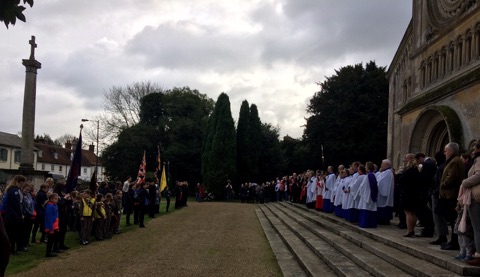
The Union flag preceded this morning’s Parade – of youth organisations and Councillors – and, back on St George’s day, as several hundred Scouts made their way into this Parish Church, it was behind both national flags – not as assertions of nationalist aggression, but of solidarity with each other and our patron saint.

Poppies, like national flags, CAN point to a narrow, triumphalist vision of national insularity and nostalgia – or they can represent a broad vision of shared national values and of continuity between the generations.

We should, I think, wear our poppies with pride – as the slogan went – and also with a tinge of regret.

And if we really do need a corrective against the glorification of war, then it’s in the very act of Remembrance – of remembering the grisly reality of past wars and present conflicts that we’re most likely to find it.

It’s a very sobering thought that, among those Scouts who paraded back in April, were young men who, had they lived in 1917, would have been wearing a different uniform and worrying not about A levels and acne, but about the much starker challenges of the trenches.
This year marks the centenary of one of the bloodiest battles of WW1 – the “Third Battle of Ypres” – which raged from July to November 1917, culminating if the capture of the village of “Passchendaele” – the other name often given to this conflict. 1917 was the wettest summer for 40 years – and Passchedaele stands out in the history of WW1 not only for the huge loss of life – around ¼ million casualties on both sides – but also the dreadful conditions in which the men fought – sometimes described as a man-made swamp.

Recalling the loss of so many young lives and the lost potential of that generation is very far from “glorification”.

It is, in fact, a reminder that war really is only a last resort – that war is itself a sign of failure – necessary only when political will and diplomacy have proved inadequate.

The point of Remembrance services, the point of wearing poppies is precisely that – is the regretful admission that war is sometimes necessary, in order to defend what we perceive to be right and good, but never desirable.

If we wear our poppies with pride – it is in recognition and gratitude that when the need did arise – there were so many who were willing to put the needs of their country ahead of their own personal ambitions.

Perhaps not all of them knew what they were letting themselves in for – especially back in 1914 some of those young men may well have marched off with unrealistic expectations of a quick skirmish and a return home as conquering heroes – but they were quickly disabused of that notion and the many who followed them did so with grim determination, not jingoistic enthusiasm.

And it’s for that determination, for that personal sacrifice –that we honour them all each year.

In doing so, we’re called to renew our own determination to ensure that we don’t squander the freedoms that they fought for – that we don’t simply pursue our own personal ambitions at the expense of our neighbours – that we are always prepared to do what is necessary to defend and promote what is good and just in the world of our day.


A final thought from the world of football.
I’m not a great soccer fan, as it happens – but it would be hard for any of us to have missed the protest that greeted FIFA’s attempt, last year, to ban the wearing of poppies by players because, it was said, they were a political symbol.

That ban has been lifted, and on Friday poppies were very much in evidence as the national teams of England and Germany faced each other at Wembley Stadium,
with its new statue commemorating the Christmas Day truce of 1914.

Both teams wore black armbands with poppies on them. And before the match began, representatives of the Army, Navy and Air Force of both nations laid wreaths and players and fans of both nations kept a respectful silence in honour of all the war dead.

In that moment the poppy became a symbol, not of division, but of reconciliation – and in that united gesture surely there is hope for the future.

Let us continue to wear our poppies then – let us remember – with pride, with sorrow and with hope.

remp17

Table Manners!

15 October 2017

(Readings: Philippians 4: 1 – 9  *  Matthew 22: 1-14)

Next Wednesday, we celebrate the Feat of St Luke the Evangelist – also known as St Luke the Physician. And so I’d thought I might pick up on that, and on this week’s news items about the shortage of family GP’s and/or the use and overuse of antibiotics, and give you a nice topical sermon this week.

And then I read this morning’s Gospel – and thought I’d better take a look at that instead!

St Luke will get a sideways “look in”, however: he also records this parable in his Gospel – but with some notable differences – and I thought it might be worth just noting those discrepancies, to see what if that might help us make sense of this slightly uncomfortable passage.

Whichever version you read, the central message is not going to be a comforting one for the Pharisees and Jewish leaders who seem to be its intended target: the King invites those whom he assumes will come to the feast and honour his son, only to be sorely disappointed – and so he invites a different set of people to take their place.
The account that Luke gives us is a simple analogy for the way that the Jewish leaders had rejected God’s son: those who saw themselves as God’s people had failed to recognise Jesus as the messiah, therefore God would call a new people who would honour him.

That’s a fairly straightforward message – and, for those who see themselves as part of that second group of people, those early Christians for whom the gospels were first written down, perhaps a reassuring one.

But then Mathew goes and complicates it with further details!

In his account, the intended guests aren’t just rude – ignoring the king’s invitation – they make things far worse by mistreating the slaves who bring their invitations.
Perhaps Matthew adds this in as a reflection of the growing hostility that Jewish Christians were facing from non-Christian Jews: when the Jewish Temple was destroyed, in the year 70, some Christians saw this as a sign that the old order had been destroyed. At the same time some Jewish leaders blamed the Jewish-Christians – seeing this destruction as God’s judgement on their false beliefs.
And so, when Matthew sets down his gospel, it’s against a backdrop of division within the Jewish faith – with those who are followers of Jesus finding themselves less welcome, and eventually being expelled from the synagogues altogether by those who rejected Jesus and his teaching.

Is this what Matthew is reflecting when he describes the mistreatment of the King’s slaves? Are we meant to recognise them as the Jewish Christians – offering the invitation to Christ’s banquet and being persecuted for their troubles?

And then the second “extra” in Matthew’s account seems even harsher – and that’s the poor man without the robe.
It’s really not clear what’s going on here and it’s hard not to feel sorry for this man: he had no idea that he would going to a wedding feast – but has responded to the invitation and turned up anyway. So it feels rather unfair to criticise him, then, for not wearing the correct robe.

The king’s initial civility – “Friend, how did you get in here without a wedding robe?” – can’t disguise the harshness of his punishment he then suffers: “Bind him .. and throw him into the outer darkness.”
So what is that all about? – why couldn’t Matthew just have left things uncomplicated like Luke!?

Presumably the key must lie in the man’s response to the King – or rather his lack of response. It’s almost as if the man doesn’t realise who is speaking to him – that he hasn’t actually bothered to find out whose feast this is, or the reason for it – the marriage of his future king.

He’s simply accepted the offer of free food – without entering into the spirit of the occasion – a gate-crasher rather than a guest. He’s really not that interested in the king’s feelings – or in honouring his son – and it’s for this discourtesy – it seems – that he faces the king’s wrath..
So, with this added twist to the tale, is Matthew perhaps sharpening the divisions within Judaism – emphasising that those who ignore Jesus (the son) will themselves be rejected by his father?

Again, to those early Christians – that would come across more as a message of reassurance – that they WERE on the right track, they were “God’s chosen ones” even if they were facing hostility for their beliefs.

To us that message is rather less immediate and possibly less reassuring – we’re rightly wary of anything that seems to cause even more divisions and religious tension.

And, unusually for me, I found far more solace in the Epistle this week – that far more approachable passage from St Paul’s letter to the Philippians – written before the gospels, and before the destruction of the Temple.

Paul is also focused on Jesus, the Son of God – but his vision here is far more encouraging and far more inclusive: “Stand firm in the Lord, Rejoice in the Lord. Let your gentleness be known to everyone. The Lord is near.”

For Paul, then, Christ is clearly present among his people – among us – not as a scolding, threatening presence but as the way to the Father and as the source of our salvation.

“Do not worry….,
but let your requests be made known to God,
and the peace of God, which surpasses all understanding, will guard your hearts and minds in Christ Jesus.”
In Paul’s experience, then, Christ is not the spoilt son of the king – sulking because no-one wanted to come to his party. Nor is he here among us to judge our motives – whether we are here for the right reasons, whether we are showing him due respect?

Christ, he suggests, comes among us – as both mediator and friend – taking our deepest concerns straight into the heart of God – protecting us both from ourselves and our own selfish desires and also from those who would wish us harm.

We don’t have to go out and buy an expensive gown before we can come to his feast – we just have to ask, and we will be provided for.

We don’t have to be perfect saints to gather round his table – we just have to come and we will be accepted.

The later wedding guests were invited, not just to eat up all the food, but to rejoice in the good fortune of the king’s son.

Christ calls us to his feast – not just to take bread and wine – but to find and receive true life and true peace.

(NEVER) Mind the Gap!

Sermon preached on the 6th August 2017 – Feast of the Transfiguration

Readings Daniel 7: 9-10, 13-14;   Luke 9: 28-36  

Today’s Feast of the Transfiguration is perhaps one that doesn’t register in our thoughts as often as it might! For some of us, in fact, the term “Transfiguration” may be associated less with the Bible than with J K Rowling’s “Harry Potter” stories – where Transfiguration classes develop the art of changing one object into another.

And if you’ve seen anything of the Athletics heats taking place in London, just now, you’ll have seen an equally dramatic “change of appearance” on the faces of the athletes, as they move through nervous anticipation, to focused preparation, to determination and then to relief, or anguish, or elation – depending on how they fare.

Of particular note, of course, was Mo Farah – whose eyes almost seemed to precede him along the track and he willed himself to victory – followed by the gentle smile of success – and then, an altogether different smile, of contentment and pride, as his family joined him on the track to mark the end of his running career. Within a few minutes, it seemed, the changes in the facial expressions of one man revealed a number of truths about him. All of them good.

In the biblical accounts of Jesus’ transfiguration – his appearance is changed, before the weary eyes of his closest disciples. This was clearly quite an experience for them – not only the dazzling vision of the transfigured Christ – but also the appearance of Moses and Elijah – heralding Christ’s own imminent departure.

Curious then, perhaps that “in those days they told no one any of the things they had seen.” That final sentence, from today’s reading, is a bit like the end of Mark’s account of the Resurrection – when those who discover the empty tomb “said nothing to anyone, because they were afraid”.

In both cases, it seems an odd reaction to a truly mind-blowing encounter. Were they “afraid” that no-one would believe them if they did speak about thee things?
Were they not actually sure that they themselves could believe their own eyes? Were those on the mountain, described as being “weighed down with sleep”, perhaps wondering if they’d dreamt the whole thing? Or was it simply TOO profound an encounter for them to relate? After all, we’re told that those on the mountain with Jesus were “terrified”, as the cloud overshadowed them.
Whatever their reasons for keeping quiet – they have been drawn into a meeting of two worlds – heaven and earth – in which the changing appearance of Jesus reveals his true identity; his true nature; his true glory.

In this diocese, some years back, there was an oft-repeated phrase from St. Irenaeus -”the glory of God is a human being fully alive”
-”the glory of God is a human being fully alive”

And I found that phrase coming to mind this week on the back of a very different kind of encounter – recorded on a documentary for Channel 4, called “An Old People’s home for 4 year olds”.

Someone had decided to see what would happen, if the energy and curious enthusiasm of group of young children were unleashed upon the residents of a rather sedate and very plush retirement home – some of whom were used to children, some of whom were decidedly not!


One particular resident, Hamish – a slightly grumpy looking man with an artificial leg – seemed to undergo a transformation ALMOST as dramatic as Jesus’, but without really admitting it!
He was adamant, before the children arrived, that this was all a pointless exercise – which would not benefit anyone and would doubtless end in tears.
And, true to form, as the children arrive, we see him sitting in his usual chair, reading his newspaper as a kind safety barrier between him and them.

But he doesn’t know about children – and if he’s not going to initiate the conversation, then 4 year old Amiya is. And soon Hamish finds himself cheerfully answering a barrage of questions.

Before long, this self-professed sceptic – who really has no time for these children or this silly experiment – is to be seen lying on the lounge floor, playing dead, and then roaring to the delighted squeals of the children.
He just seemed to forget that he was supposed to be grumpy – and, for a while, we glimpsed the 4 year old Hamish peeping out from an older shell.
And there were other transformations. One lady, who had no children or grandchildren of her own, and had just lost her husband – rarely moved from her chair and was displaying signs of depression. She found herself “adopted” by one particular girl who just wouldn’t leave her sitting there to mope. Quite remarkably, she changed before our eyes.

There was a sports day – with the slightly scary sight of normally gentile octogenarians pushing themselves to new limits – three-wheeled walking aids whizzing along the track at speeds they were not designed for –
but, fortunately, no casualties!

There was an end of term assembly – for the children’s parents – with both residents and children side by side.

It was a really moving encounter – on lots of levels.
In some cases it quite literally seemed to bring back to life some who’d really given up on living. Young and old together gave a glimpse of what it is to be “fully alive” – and it left you wanting to see more of this, not on the TV screen, but in the community at large.

We live in a society in which the generations seem to be more separated than ever – both by the rapid pace of change and differences in upbringing – and also by the heightened concern to protect children from unfamiliar adults.

That protection is necessary – as is the need to protect vulnerable elderly people. And yet, there must be a way to provide safe spaces where the generations can encounter each other – and where young and old can help each other to a fuller understanding and engagement with life itself.

And I think there’s a challenge in that for us:
can we find ways to make this parish church OR perhaps the people of this parish church the natural “meeting space” for people of different ages and backgrounds?

Can we somehow draw our disparate neighbours to each other – in ways that will allow us all to discover, or perhaps rediscover, hidden depths within ourselves – the glory which is a human life lived as fully as God intends.


This year there have been lots of things bubbling up here – signs of new life budding into growth.

Now is a good time, I think, to really take stock and see how we might develop some of those things – to benefit more of us, and more of those living around us.

I’m hoping we’ll have an opportunity to do just that, after the holiday season is over, with another Parish Planning day – something we haven’t done for quite a few years now.

And so, before then, during this relatively quiet time of the year, can we consciously think back, and look out, for examples of other social groups and church projects that inspire us?

Are there ideas which we could explore – simple ways of reaching and connecting people which we could offer?

And if you CAN think of encounters of this kind, that have impressed and moved you, please don’t follow the disciples lead, and keep it to yourself!
It may just be the good news we all need to hear.

At the transfiguration of Jesus, God’s glory is revealed to ordinary people through the transformation of one Man.
Let us hope and pray and work for the transformation of our lives and those of our neighbours – in such a way that God’s glory shines through us all.