“Love is…”

Address for 17 May 2020

Readings: Acts 17: 22 – 31   John 14: 15 – 21

“If you love me, you will keep my commandments.”
“Those who love me will be loved by my Father, and I will love them, and will reveal myself to them.”

Jesus’ words take us back before Easter again – as he prepares his friends for his death, and for the time when he will no longer be with them, in the literal, physical sense.
They don’t yet know how Jesus will die, let alone the nature of his rising again and his ascension into Heaven, but, in this farewell speech, he assures them that God’s Spirit will be with them and in them, that they will in fact see Jesus again, and will live because he lives; and that they will be loved by God, his Father and theirs.
And the key to all of this assurance is love – if they love him then they will keep his commandments.

Jesus himself boiled down his teaching to two principal commandments – “Love God; and love your neighbour as yourself.”
Beautifully succinct and, I think, rather ingenious in the way it neatly sneaks in a third commandment along the way: “love your neighbour as yourself” implies also that you must “love yourself”!
In recent weeks, many of us have had more time to ourselves than usual – time in which to become painfully aware of our own personal foibles, flaws and fears – all of which may tend towards self-loathing, rather than to loving ourselves.
And yet, if we can grasp it, our changed mode of living gives an opportunity for a little “self-improvement”. Whether by learning new skills, or by deliberately trying to learn more about God and our neighbours – we can begin to appreciate more fully the life that we all share and to love more genuinely.
It’s perhaps easier to think about loving our neighbour than it is about loving God – more easily understood in practical terms.
And certainly the response, among our neighbours, to the current lockdown has been quite phenomenal: the most recent figures I’ve seen for the official Wilton Covid 19 response team cited 113 volunteers; 1220 calls answered; 333 prescriptions collected and 274 shopping needs undertaken. And that’s 2 weeks out of date – so even more by now!
That speaks to me of a vibrant community – willing and ready to work together for the good of all of us, and especially the most vulnerable.
That speaks to me of “love in action” – even if some of those 113 volunteers might well blush at that description!
It’s perhaps the individual acts of kindness that have spoken most directly to us, in recent weeks – the concerned phone call, the extra bit of shopping for a neighbour, the friendly greeting from a neighbour we don’t normally see; and, at least in one case I know of, the bag of flour for someone craving a bit of therapeutic baking!
For me personally there was the novel experience of celebrating a birthday in lockdown – which provided my family with the extra challenge of finding suitable presents that were a) still available to buy and b) had even a remote chance of arriving in time. In the event, they did rather well – perfectly gauging my current cravings .. for music, food, coffee and fitness! And there is love – demonstrated in the thought and the sourcing of those things.
And yet it was another gift which actually brought tears to my eyes – a simple packet of biscuits, left on my doorstep, by two of our younger servers.
Here again, I realised that some people know me rather better than I think – I do have quite a craving for most kinds of biscuits. I think what really moved mem though, was that their gift was totally unexpected. It was a surprise in the best sense.

And I want to suggest that it’s in those unexpected acts of kindness that we might glimpse something of God’s love for us.
As we recognise that we are not after all, separate beings, motivated purely by greed or self-preservation, we begin to find meaning beyond ourselves and our immediate surroundings.
At some stage I hope that I’ll be able to hear some of your stories of lockdown – the people that have touched your life and surprised you with kindness, the times that you have glimpsed God’s love in all this – and soon perhaps we can compare notes and see what we make of it all!
Christ reveals himself to us, then, in the “goodness” that lies behind the actions of our neighbours – reminding us that we are never truly alone, reminding us that we are loved.
And how are we to love God? What can we do to signal our gratitude?
Most simply we can just talk to God – however strange that may feel at times, we need to at least try to express, to God, our thoughts and our shifting emptions.
Polls this week suggested that, over the past few weeks, around 45% of the population have turned to prayer – of one kind or another – as we seek solace and some kind of meaning.
And the response to the Daily Prayer on our Community Facebook Page, Wilton Chat, seems to confirm that we ARE indeed talking to God more frequently just now.
In making the time to do that, we offer to God a simple gesture of love; and we open ourselves to receiving the love which Christ promised to reveal to his friends.
Can we then, both by celebrating the many acts of kindness to us, and around us, and by praying often and without restraint, begin to know ourselves better; to know our neighbours better, and to know God, who knows us better than anyone?
May Christ enable us to find our place within that eternal cycle of love – loving God because he loved us first; loving ourselves because God loves us, and loving our neighbours because we feel God’s love welling up inside us, and we just can’t keep it to ourselves.. Amen.
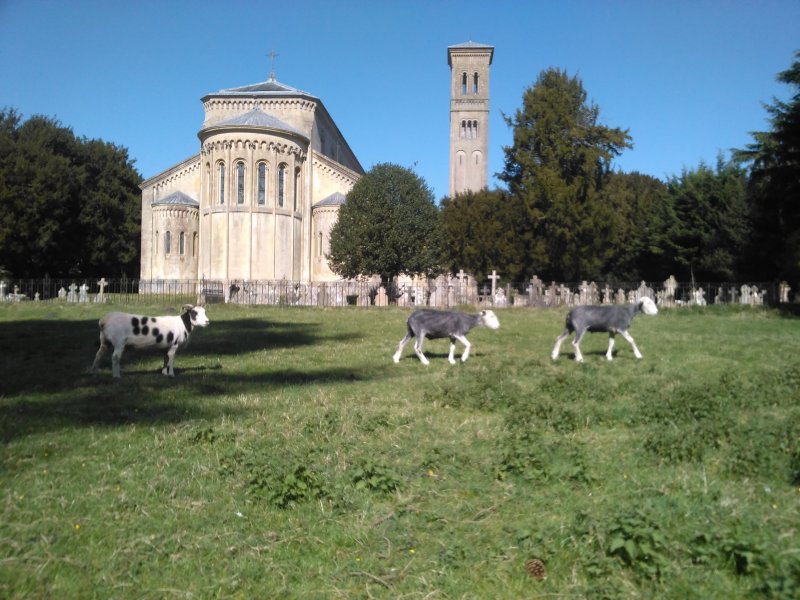
Penned up, led astray or guided safely ?

Reflection for 3 May 2020

Acts 2: 42 – 47: Psalm 23: John 10: 1 – 10

It’s a lovely image in John 10 – the shepherd gently summoning each sheep by name. They recognise his voice, and instinctively trust him – whereas they’d shrink back from the stranger, who is intent on stealing them, rather than caring for them.

church sheep

And when, a couple of years ago, my family first acquired sheep – as pets and natural lawnmowers, rather than livestock – I was really pleased to discover that they did respond to MY voice.
I could stand at the edge of the top field, just behind the church, and call them – and they would gallop round from the lower field to meet me.
Blissful – at least until the realisation a couple of week later, that exactly the SAME effect could be achieved simply by rattling the feed bucket: it wasn’t so much that “my sheep hear my voice” as ALL sheep like eating, and my presence had come to symbolise feeding time!
Ah well.

In this passage from St John, it’s important to note that Jesus does NOT identify with the shepherd – that saying comes a few verses later.
Here he says, “I am the gate for the sheep” – which doesn’t immediately seem that attractive – barely one step up, perhaps, from being the doormat.
But what is the gate actually for?
It is there, of course, to keep the sheep safe – to keep out any bandits or wilds animals – but, significantly, is also the safe way out of the fold.
The sheep will sometimes need to leave their enclosure, in order to find fresh, and more abundant grazing. And that brings both opportunity and potential danger, they need to be guided in the right direction – and so, the gate keeps them firmly penned in, until the shepherd arrives, and leads them “along right paths”, to the places where pasture is lush but predators scarce.
Jesus the gate then, just as much as Jesus the Good Shepherd, represents the safe and trusted way – out of confinement and out into an abundance of life.

Unsurprisingly, I found a certain resonance in that imagery with our own situation just now: here we are, mostly, locked away in safety – our own front doors providing the same barrier to keep out the unseen dangers of COVID 19.
And yet we too know that we must as some stage look beyond that barrier – and step out into the world again, if we are going to have any hint of abundant life.
And so, if we dwell on these things, we are forced to consider “who NOW do we trust?” – to lead us safely out again?
Whose judgement to we trust to release us at the right time, and in the right way?
How do we restrain ourselves from rushing out like giddy sheep, straight into the jaws of danger?
It’s not easy to know whose voice to trust – especially when it’s not clear what motivates the speakers concerned.
Worth noting perhaps, that not all those now advocating a swift relaxation of restrictions will have your or my best interests at heart.
And equally, not every hard-nosed objection to any such relaxations are necessarily well judged.
Whatever steps are taken in the coming weeks, to enable businesses and other organisations to function more normally, I hope and pray that we will not lose sight of the need to both what is best for us all, and what is necessary to protect the most vulnerable.
The sheep gate isn’t flung open just as soon as the shepherd has appeared on the horizon.
The good shepherd doesn’t just lead the strongest and most valuable sheep to safety.
Of course, regulation changes are beyond our control, but we can at least take responsibility for our own actions in the way we respond.

And while we’re pondering whose voice we think most trustworthy, perhaps we can discern similar truths about ourselves … if it’s not stretching the sheep-fold imagery too far!
If Jesus will us life in abundance – then can we begin to search for that fullness of life right here, at home?
Are there things about ourselves that we keep safely hidden inside us, in order to protect ourselves – whether from judgement or rejection by others – or from admitting to ourselves our own failings or weaknesses?
Can we now face up to those things – accepting ourselves fully and honestly – so that we can then engage MORE fully and honestly with “the world outside”, or at least with our friends and neighbours .. the rest of our “flock”?

Carved round the Font in our cathedral are words from Isaiah 43, which are often spoken at Confirmation services: Thus says the Lord: “I have called you by name, you are mine.”
God already knows us – better than we know ourselves.
There is no use trying to hide from him our weaknesses or frustrations. There’s no use trying to pretend we are anything other than ourselves.
Yet Christ waits still to lead us beyond what WE already know – the new life of Easter is not just his rising from death, it is about US learning to live abundantly with whatever we have; learning to see beyond our own doubts and insecurities, and trusting that there is more to life for us; learning to see beyond our own interests, and trusting that there can indeed be abundance of life for all people, not just the confident and strong.
In the earliest days of the Church, we heard in our first reading, many were baptized, and added to the community, largely because of the quality of that shared life – of the concern shown towards those in need.
Is that the lesson Christ is now calling us to learn – outside the spiritual safety of our familiar Sunday services?
Are we being challenged to rediscover what really marks us out as Christians, and to step up to the mark?

Time will tell, but our starting point in all this is to be ready at the gate – listening for the voice of Christ – and ready to follow him, before all else.

All in the eyes of the beholder??

Address for “Low Sunday” – 19 April 2020

“Seeing is believing” – those words echo down to us from the Ancient Greeks, and from many other thinkers and commentators in between.
And, shaped as we are by three centuries of Scientific Rationalism, it seems only logical that we trust what we see with our own eyes more than anything anyone else might tell us.
And this appears to be borne out by that account of Thomas – or doubting Thomas as he’s often called.
He’s heard the testimony of the other disciples, that THEY have seen Jesus, risen from the dead, but he won’t accept that testimony: unless HE sees Jesus for himself – sees his wounds and touches them.
Thomas wants empirical evidence before he believes – after all, seeing is believing!
And yet I’m not sure that’s necessarily what is happening here.
Even from a scientific perspective, the assertion that “Seeing is believing” seems overly simplistic.
For decades now, thanks to increasingly sophisticated technology, astronomers studying deep space have found themselves looking at things that existed millions of years ago, and having to make assumptions about what’s out there now. The distances involved are just too great for any of us to “see” what is actually there.
And, at the other end of the spectrum, Particle Physics has long worked with subatomic particles so miniscule that, again, no human eye could hope to “see” them in any meaningful sense of the word.
In both cases, then, rational scientists have developed theories based not so much on seeing actual “things” – observable objects – as on the effects that those supposed “things” have. We observe the way that space or matter behaves and what might affect that behaviour and make rational deductions about what is. More often than not, those deductions prove correct, or at least convincing, but it’s a long way from “seeing is believing” – from believing ONLY what can plainly be seen and tested. At the very least I’d want to suggest that the “believing” bit comes first – forming a plausible explanation in our mind’s eye and ten seeing if there is evidence around us to back it up.

And if that’s how the world of the science operates, what about “religion” and the nurture of faith?
Again we find ourselves dealing with things that can’t be seen – but which can be sensed very profoundly, in the core of our being. Sometimes we know, beyond doubt, new realities which we simply can’t put into words – let alone explain, to our own rational minds or to someone else.
I’m reminded of another familiar phrase –“faith is caught, not taught”, implying that Religious belief is NOT just about passing on information or trying to prove the historical truth of some Bible story or other. It’s far more about sensing what is truly good – and sensing what is truly God.
Thomas asks to see and touch Jesus if he is going to believe – but it’s actually what he hears that moves him: Jesus speaks to him, perhaps even speaks his name. Thomas knows then, beyond any doubts screaming away in his logical brain, that his IS his Lord and Saviour. Jesus calls and Thomas believes.
Now, as then, no amount of talking about the Risen Christ is any substitute for encountering the Risen Christ ourselves.
It’s interesting, I think, that this episode come in the middle of three similar encounters.
Last week it was Mary, at the empty tomb – distraught that her Lord is not there. Then she does see him, but doesn’t know him until he calls her name – then she believes.

Thomas is adamant that he will not accept that Jesus is risen unless he sees for himself what the others have told him. And then, when he does, it’s almost as if that doesn’t matter any more – what does matter is that Jesus is speaking, and speaking to him.

And then, next Sunday, we’ll hear about the disciples on the road to Emmaus – bemoaning the loss of Jesus, even though they are in fact talking to Jesus himself!
They see but do not believe: they do not know him, until he breaks bread, and speaks the words that he said to them at another supper – on the night before he died.

Seeing, it appears, is never enough – even those with rather better eyesight than mine – have a habit of overlooking the blindingly obvious or of choosing not to notice the things that don’t fit with what they already believe or want to believe.
Our logical, cautious minds have a tendency to keep us in safe, predictable territory – even when the world around us sings of the, as yet, unexplored life that God intends for us.

Mary, Thomas and the disciples on the road all testify to the reality of things that cannot be seen or touched – of those profoundly sensed truths that I spoke of earlier.
For us, as with Thomas, it’s not enough just to be told that Christ is Risen; it’s not enough to read it in the Bible, or see it depicted in religious art; nor was it enough, for Mary or Thomas, just to see Jesus the man.
Somehow we need to sense that it is true – it needs to “make sense” to us at some deeper level.

It is the flow of love – as Jesus speaks to his disciples – that dissolves their doubt and strengthens faith. They don’t really know how they know it’s him – somehow they just know that they know.

It’s that same “flow of love” to us that we need to sense in order to believe,
that flow of love from God to others, that we need to sense in order to recognise Christ at work among us; that flow of love to others that we must replicate – if we are to claim, with any credibility, to be Christ’s body now on earth and to make him known.
In the strange world of 2020 – perhaps all those things have become a little more challenging – cut off as we are from our normal mode of existence and our normal channels of communication.
Yet, as Mary, Thomas and the other disciples learned the risen Christ has a habit of surprising us – of appearing when we least expect him and in a guise that we may not at first recognise.
In the pregnant pause of this current lockdown – can we pay attention to all our senses and be shaped and reenergised by what we discover?
Can we still our troubled minds long enough, and often enough, to bathe in the goodness that is flourishing around us?
And, with the eye of faith, can we recognise there the Risen Christ – who even now walks among us and holds together all of us and all of creation?

May the peace of the Risen Christ be with you – today and always.
Amen

Easter Sunday Sermon 2020

“Breaking in” or “breaking out”?

Address for Easter Day 2020

Reading: Matthew 28: 1 – 10

There is a real mixture of emotions in today’s Gospel reading, I think: if anyone ever tells you that the Bible is boring, then I suspect they probably haven’t dipped into it very often!
In this story there’s real sadness – as the two Mary’s make their way to the tomb.
I suspect there’s also boredom – for the guards who’ve spent all night on sentry duty – watching over a dead man.
There’s anxiety – fear – for the women as they first see the guards sitting there, and for all of them when the angel makes his dramatic entrance.
And there’s a confusion of emotions as the angel explains things – hope battling with sheer disbelief; and even more so when Jesus himself appears – the women’s deep joy and their sense of unreality both vying for the top spot.
It’s really all too much to take in.The same might possibly be said for us, as we live through the unchartered experience of lockdown. Perhaps we are wrestling with conflicting emotions, as we try to make sense of conflicting evidence and as we struggle to comprehend the enormity of it all.For us there is sadness – at the lives that have been lost and loved ones separated.
There is boredom at times – perhaps as we fight our own instincts to enjoy the warmer weather by heading out into the countryside or off to the coast.
There is anxiety – as we wait to see how things will develop; as we wonder when things will start to get better.
We are encouraged. I’m sure, by the generous response of our neighbours to those who need help – delighted to witness a real flourishing of community spirit here – and yet, still it’s quite at hard at times to believe any of this is really happening at all!The point of the gospel story is that what lies ahead for the two faithful women, is far better than either of them could possibly have imagined – out of the horror of Good Friday and the sadness of Holy Saturday comes new life, not just for Jesus, but for everyone and everything
And the similar challenge that faces us is to believe that, when this pandemic is over, we will not be faced with a struggle to get back to what we had before.
Through faith, we may instead find our way towards a better way of inhabiting this planet.
I promised to talk about the egg – which, on a normal; Easter morning, sits in pride of place at the front of the church just up until this point in the service.
And then I’d chose two children to carry the egg through the church to give everyone a sight, and possibly even a scent of it, (and hoping all the while that neither child is unusually accident prone!)
If I allowed them – to carry straight on and out of the doors – then they’d head home with quite a prized: enough chocolate for weeks!
What does happen, of course, is that other children then tale it in turns to crack the egg – so that it can then be broken further and shared out.
Unless it is broken – we can’t make sure that everyone will get a piece to eat later.Jesus is broken on the Cross so that the sheer scale of God’s power to transform can be revealed – nothing is so devastating that it can destroy all hope – nothing is so terrible that it cannot ultimately be turned towards the good.Fears have been expressed this week that economic and political systems across the world are breaking down – under the pressure of enforced lockdown in several countries.
And many of us are rightly concerned about what that means for our economy – whether our local businesses will survive; what the effects will be on my livelihood, my job, my savings, my pension?
Wouldn’t it be wonderful, then, just to step back to normality again – and get on with whatever our ordinary tasks may be?And yet, as the women at the tomb discovered, what came just before may not be the best thing to hope for or aim for. The risen Christ was not the man they had known two days earlier– or at least not just the same man.
His resurrection changed the picture completely.
It is just possible that the creaking structures battling to remain in place today may break, to produce something more just and more stable, and not the financial black hole that some are dreading.Forced to stay at home, members of sports teams and music groups are unable to meet to hone their skills in the usual way – and there will be real challenges ahead when they finally do meet together. And yet, as skills are re-learned, might there be an opportunity to shed bad habits; and perhaps to appreciate more fully the skills and contributions of others in the group – to really prize the team effort over personal ego.
And I guess that thought transfers to the Board room too.Just now, some of us are lonely, some of us are frustrated because we cannot see the friends we normally spend our time with.
Some of us are suddenly dependant on neighbours we’d never met before – but whose kindness and concern are now our salvation.
There is so much good that can come out of that realisation – as again we really learn to value all those people and what they mean to us.And, of course, there are places we can’t see at present.
Every month Google Maps provides me with a timeline of all the exciting places I’ve been to. And this week, in popped the summary for March.
It listed 3 great cities that I’d visited – Salisbury, Egham and Fovant (that well known metropolis).
And then it lists 3 highlights – Rivers leisure centre, the Garden centre and Lidl! Talk about living the dream!! And yet I really wouldn’t mind even half an hour in any of those places just now, just for a change of scene.
By being “grounded” in this way, though, might we learn to appreciate just how much there is on our doorstep – local facilities and natural beauty.
And might it lead us to think how we travel and how often? Could we use our cars less in order to keep the cleaner air that we’re now breathing?The reason that you are now listening to my dulcet tones via the internet is that we can’t now gather in church – and that’s particularly hard for us on this most holy of days when we’d normally have a busy, joyful celebration.
Yet can we, by this grasp what it is to be what Pope John Paul II termed “an Easter People” – filled with the new life of the risen Christ, worshiping together, not just with the comforting familiarity of the “normal”, but with the boundless joy and expectation of the two faithful women on Easter morning?
We don’t know what life will look like in 2 months, 6 months, or a year’s time – but if the story of Easter tells us anything it is that there is no reason to assume that it will not be at least a pleasant surprise.
In these strange times, and in all circumstances we are called to celebrate and to witness to the power of Christ’s Resurrection:
for we are an Easter people and Alleluia is our song!

An “Unholy” Week?

Palm Sunday 20

Here we are then at the beginning of Holy Week – and yet, it doesn’t really feel like it!

For me, this is normally the busiest time of year:
with a range of services and acts of worship to be prepared and delivered;
special services to be “re-learned” and then rehearsed with the team of servers;
practicalities to check – such as the building of the Easter bonfire or the acquiring of super-sized chocolate eggs for our two main congregations;
liaising with our friends at the Baptist Church ahead of Good Friday’s walk of witness.

So it’s very odd this year to find myself still busy – but doing none of those “normal” things,

Instead, together with Caroline, our Curate, the main task, just now, has been in trying to keep some form of contact with the members of our congregations and also to offer some kind of Easter experience for the communities around us.

And so the last 2 weeks have involved, not only busy phone lines, but something of a crash course in social media! Our Facebook page has been hastily reordered – the world of You Tube has been explored and our Parish website linked to more resources, such as meditations and prayers for use at home.

And then, of course, there’s been the corresponding task of writing, selecting, recording and editing material to post at those various “outlets”.

That’s been an interesting experience – if at times frustrating and equally at times very moving in the responses that I’ve received.

But none of it quite takes away the sense of “absence” – the sense that this is not how Holy Week is meant to be.

And that brings with it a sense of powerlessness – even if that is coupled with a conviction that staying at home IS the right thing to do just now.

What I think a number of us are experiencing is a kind of “slow motion” Easter: we’ve already sensed the loss and uncertainty that Jesus’ friends experienced as he was lost to them.

There was a palpable sense of shock – when churches were closed, and our normal way of worshipping together taken from us.

Even being told to stay at home – in fairly stark terms – was quite hard for those of us more used to be out and with other people. That loss of freedom is difficult.

And it’s proved something of a shock for families used to going their own separate ways during the day – for work or school or college: suddenly being together all day and every day, with no other company to dilute the mix, demands new rules of engagement if the battle for personal space is not to be lost as well.

Harder still is the enforced separation of those unable to visit loved ones who are sick or dying – and the double sense of isolation that brings.
We share perhaps the disciples’ sense of disorientation as familiar patterns and routines are lost. Like them we find ourselves in a situation where everything we thought we knew – everything we were expecting – has been thrown out. We don’t know what is going to happen next; we don’t know when we’ll get back to “normal”, or even what “normal” is going to look like when we get there.

And there’s a certain amount of confusion around too.
I have to admit that I sometimes struggle to remember what day it is, now they all seem remarkably similar!
And for those now working from home for the first time, there’s the fresh challenge of demarcating work time and family or leisure time: how do we know when to “clock on” and “clock off”? Can I do a couple of extra hours work today, while it’s quiet, then a bit less tomorrow?
And will I remember?!

Am I, at this moment, professional, partner, parent or all three at once?

How can I anchor myself in these strange waters that I’m now forced to navigate?
Shock, disorientation, confusion – in many ways, our loss of church worship and the loss now of our usual Holy Week observance, both sound rather like bereavement.
Those three emotions, that we usually associate with grief, do seem to be present now, as we live through this gradual and sometimes painful process of adjusting to a different way of living.

We shouldn’t be surprised then if sometimes we find it hard going – if our emotions sometimes lurch in response to certain triggers: living where we do, alongside the Parish Church, I can’t help noticing the lack of bells on a Monday evening; or of the sound of organists practising on Tuesdays and Wednesday; or of the strains of the choir on Thursday evenings.
For now the church stands silent – a physical reminder of the “absence” we feel – a reminder, we might say, of the silence of the tomb.

This, then, is our Holy Saturday experience: like the disciples we know what we have lost, but we can’t yet see the joy that lies beyond. Like them we are forced to hide away, in the relative safety of our homes. Like the first Christians, we are forbidden to gather in public.
And yet we do know that this will not last for ever –
we don’t yet know when it will end, but do know it will.

A very particular perspective on this was offered, this week, by Terry Waite – who, in the 1980s, was envoy for the then Archbishop of Canterbury, Robert Runcie.
In 1987, Waite was sent to Beirut, to try and negotiate for the release of two American hostages. In the event he was himself taken hostage, and kept in cramped conditions for over four years.

It’s with a particular wisdom, then, that he gave advice to any of us struggling with our current isolation.

First of all, he said, we need a change of mindset: we are not “stuck” at home, we are “safe” at home”.

There is a real difference.

In order to cultivate that positive frame of mind he suggests 4 practical steps:
1 – keep your own dignity – don’t sit around all day in your pyjamas!
2 – Form a structure to your day – that might mean set times each day for prayer, for exercise, for meals
3 – Be grateful for what you have – not least for the shelter that our homes provide, and something not everyone does have.
4 Read and do something creative – don’t just sit and fret about things, feed your mind.

So, can we use this enforced stillness to notice the good things that are there for us?
Without the usual volume of traffic we hear the birdsong more clearly.
Without our daily encounter with the usual people, our fleeting conversations – from a distance, on the phone or by other means – somehow mean more to us.

Can we use this time to really appreciate the things we are missing – even simple things, like pasta or Reeve’s cakes!
Can we use this time to really appreciate the people we depend on – those in our pharmacies and medical staff, for example.

And what about the things we can now do – that we’re normally far to busy for – or that we can now do differently, in more creative ways?

One of the many posts that caught my eye on Facebook read “In the rush to return to normal, it’s worth asking which parts of normal are really worth rushing back to.”

We can learn from this experience – we can grow through this period of restriction and come out the other side renewed and refreshed.

We can yet discover again what is truly precious to us; what is vital to our communities, our society, our planet;
what is fundamental to our faith and our church.
Of course, I am NOT trying to suggest that this pandemic is some kind of blessing in disguise: for those who have lost loved ones, Covid 19 represents a devastating loss that can never be undone. It would be crass to suggest otherwise.

And yet, even then, our faith refuses to see a dead end.

The experience of Good Friday was agonizing for Jesus himself AND for those who loved him – forced to stand by helplessly, unable to do anything to ease his suffering.

We know now that through his suffering the world was changed for good – God’s love for us revealed,
the way to eternal life opened to us.

From this time – with all its frustrations, hardship and grief – still good things can come and will come, if we enable them to.

May God give us grace to trust in him who suffered, died and rose again for us – knowing that we will rejoice again, in his presence and in each other’s company. Amen.

What are you “waiting” for?!

Sermon preached on 15 December 2019 – Advent 3

Readings Isaiah 35:1 – 10; James 5: 7 -10 and Matthew 11: 2 – 11

Bathed in the Autumnal sunshine of the October half-term, a group of us cleared a huge amount of greenery from our church car park – almost 2 skips worth! And as we hacked away, we suddenly came across a coil of chicken-wire – obviously put there to protect something.
After further investigation, and more clearing, someone with a longer memory of Wilton than me said:
“Ah, that’s the millennium yew!”
And indeed, there was – and is – a dark green yew tree not very tall, having been comprehensively smothered, for several years, but very definitely alive!

At the time, I’d assumed this was some quirky Wilton tradition – a wooden millennium cross erected in the old churchyard, a new yew planted in this one.

But then, yesterday, I heard a tribute to the late David Bellamy, in which it mentioned “Project 2000” – an initiative inspired by him, which encouraged churches up and down the country to plant a Yew tree to mark the new millennium. So that, presumably, explains why there is a millennium yew in our churchyard, which hasn’t figured that much in our collective consciousness!
For the benefit of those who don’t know who I’m talking about – David Bellamy was a TV personality in the 1970s, 80s and 90s – and a trailblazer for ecological conservation long before it became the live issue it is today.

His particular interest was biodiversity – with a concern that we didn’t lose any of the species of our natural countryside. And he surprised many people, in later life, by saying that he didn’t think much about global warming – something regarded today as a primary driver for loss of species.

And it’s a sign, perhaps, of how things have moved on – that in the same week that he died, Time magazine named Greta Thunberg as it’s “person of the year.”

A new generation has produced a different ecological champion, with a very different outlook – although the fundamental aim of conserving the natural world, remains the same.

She is heralded as something of a prophet – and like all prophets before her – her words cause sharp and polarised reactions, from those who hang on her every word to those who write her off as an irritating upstart.
Such prophetic voices are not only hostage to developments, over time, in our collective understanding, but also to the popular mood of the moment.
And that can change very quickly.

Spot light on John the Baptist. It always seems odd, at this time of year, that he gets two bites at the cherry – featuring in last week’s gospel reading and again today. But note the difference – last Sunday he was flavour of the month – the crowds flocking to him for baptisms, even when he was seriously rude to them
Now he’s in prison, awaiting his grisly fate – his moment of glory has past.

And yet, in today’s reading, Jesus seems to be assuring him that his legacy is already secure – that Jesus himself IS the one John had been waiting for, and that John can now safely hand on his life’s work to Jesus.

John himself had always been clear that he was not meant to be centre stage – his role was to prepare the way for one who is greater than him. Jesus, in turn, pays warm tribute to John – “among those born of women no-one has arisen greater than John the Baptist”.
And yet – still, he asserts that John is the messenger, not the message: pointing to the kingdom but not yet “of” the kingdom.

Every prophet, it seems, plays his or her part in the greater transformation of the world by disturbing the consciences of men and women of their own time, inspiring them to look further and to seek the kingdom of God – but each is limited by the knowledge and culture of their own time.

Perhaps, then, our Advent our readings encourage us to acknowledge the legacy of John – and all those who’ve proclaimed the kingdom of God in earlier ages – AND, at the same time, to look out for the signs that God’s kingdom is already breaking into and transforming our world, and to play our part in bringing about that transformation:
to look out for the signs that Christ IS present in our time and in this place, to allow ourselves to be transformed by his message of redeeming love;
and to encourage the next generation to grasp that message and to interpret it for the world of tomorrow.

Wait and see!

Sermon preached on 17 November 2019

Readings Isaiah 65: 17-25 & Luke 21: 5 – 19

Part of my Saturday routine involves nursing my brain into consciousness to the strains of Radio 4’s “The Curious cases of Rutherford and Fry” – a 15 minute programme in which Doctors Rutherford and Fry investigate scientific mysteries sent in by listeners.

Yesterday’s offering was a little unusual in that the listener in question was the comedian and presenter Stephen Fry – so it became the curious case of Rutherford, Fry and Fry.

What was troubling him was his own prosopagnosia – or “face blindness”. Like a surprising number of people, it seems, Stephen Fry, has great difficulty remembering people’s faces – and therefore recognising them.
He may well know the names and personalities of the director and every single cameraman while on set – filming some production or other – only to find himself standing in the canteen queue, later, and asking one of those same people what they do for a living. All very embarrassing.
And we heard the case of the sheep farmer, who could identify every single animal in his large flock, but couldn’t recognise the members of his own family. And you can imagine how they felt about that!

Then there was the school girl who relied on another person’s distinctive manner of dress to help her work out who they are – but who found school something of a nightmare, because all the students wore the same uniform! So, no visual clues to rely on.

And what the two radio sleuths discovered is that, although some cases of face blindness are caused by an accident in later childhood or adulthood, in the vast majority of cases it’s a lifelong affliction.

Most babies learn very quickly to recognise a small group of people – just as other species might learn to recognise the distinctive sound of their parents’ cries, so they can identify each other within the group –
And prosopagnosia, “face blindness”, is a failure of that survival mechanism to kick in.

For the majority of us, however, that instinct remains with us – we learn to see the things that are important – not only for our survival but also as part of the human brain’s never – ending search for meaning. We pick out the things that interest us, or reinforce our own way of viewing the world – which others may not.
As Dr Rutherford commented, the stories we hear of someone finding the face of Jesus on a piece of toast, or the image of Mother Teresa in a root vegetable, always feature people who are already inclined towards religious belief – we recognise what we have learned to see.

A different example of the search for meaning popped up, out of the blue, at last Saturday’s concert, here. Afterwards, I was approached by a member of the audience, who regards himself as a classical scholar, and who was puzzled by what is painted up above the choir.
There, below the cross of Jesus, are the two words “Salus mundi”. And while there’s no problem with mundi (world) – he didn’t recognise the word salus.

And while many of us who’ve sung in church choirs will have some across the phrase “Salvator mundi” – O Saviour of the world – this phrase, salus mundi is not so common.

So, I thanked him for my homework and said I’d look it up. And I discovered, among other things, that it is the motto for the state of Missouri, in the USA – where it is translated as “the welfare of the world” and that it appears elsewhere to mean “the salvation of the world”, the “healing of the world”.

Through the Cross of Christ we are meant to recognise the saving power of God – to anchor us in present difficulties and to point us to the new order of things that God is creating for us.

Like the old Sunday School joke, the suggestion painted here is that Jesus really is the answer to every question!
Yet, Jesus himself cautions that the answers we seek may not be that clear cut, and not that easy to recognise.

When he predicts the destruction of the Jerusalem Temple – the disciples want to know when and how this will happen. And at this stage of the Gospel, as tensions rise, there are many others who are asking similar questions – trying to force events into some kind of logical and religious pattern that they already know.
But Jesus simply carries on being himself –
doing exactly what he’s always done –
leaving everyone else to wait and see.

And it’s clear from what follows that, though Jesus may be the answer to our problems, he does not offer his followers immunity from hardship, from confusion, from disagreement – but the assurance that , by faith and faithful perseverance, we will come through and out the other side; seeing more clearly what it was all about.
“By endurance you will gain your souls”, he says.

In similar vein, our reading from Isaiah sets before us a vision of transformation – so powerful that what has been simply ceases to matter – a transformation based on a proper relationship with God; not just of individual souls,
but of the cosmos – all things in balance and true harmony with God’s will.

Again, that relationship depends on our learning to recognise the signs of what God is doing – even in the uncertainties of our own lives, and in the messiness of the world around us.

As we head towards Advent, then, perhaps both these readings encourage us to resist the temptation to try and nail down every detail of our lives – what we will do, when and how we will do it – and instead to try to attune ourselves to recognise the signs God gives us:
to see the face of Christ, perhaps not on a piece of toast, but in the face of other people;
in the things that they do;
in the richness of life itself.
And from there to respond and be transformed ourselves by what we see.
Two weeks ago, at All Saints – we ended our Eucharist with a sea of candles – each saint bearing their own light as a reminder that each of us has within us a smaller reflection of God’s own light – which is there not only to guide ourselves, but one another.
Sometimes we may struggle to see that in another person – as if peering at it through fog, as we really don’t get where they’re coming from; or we may experience someone else’s holiness as a rather severe and harsh spotlight on our own inadequacies and failings, leaving us feeling awkward and ashamed; and sometimes we may experience that same light as the gentle, comforting glow of a fellow pilgrim walking the same path with us.

Advent, I think, should bring all of those things – the path ahead being neither too safe nor predictable, and yet surrounded by signs of hope.
Somehow we need to remain alert and yet patient – drawn on by the vision Christ sets before us, but not so anxious to get there that we miss the vital signposts along the way.
Jesus bids his friends “wait and see” – for us, then, Advent is a time to make sure that we do learn to see, and not just wait.

Doth the lady protest too much?

Sermon given on 20th October 2019

Readings: Genesis 32: 22 – 31   Luke 18: 1 – 8

Yesterday, with the eyes of the world upon us, a decisive victory was won: a victory which will restore our credibility on the international stage; a victory which will have an important bearing on our future standing among our neighbours; a victory which was clearly right and proper.

I am, of course, referring to England’s triumph against the Aussies in the Rugby world cup – a welcome distraction from anything else that may have been going on back home!
And if “perseverance” was a hallmark of that particular match – and of certain individual players within it – it’s also an underlying theme in the various readings set for today.

Firstly, there’s Jacob – who struggles all night against the unknown challenger, whom he then understands to be God himself. In doing so he wins the stranger’s blessing – achieving through sheer determination and perseverance what he had previously tried to win by deceit:
you’ll remember that he had cheated his brother Esau out of his birthright by deceiving their blind father, Isaac into giving him his blessing instead. And he’s only alone at the beginning of this struggle because he’s sent the company ahead to try and appease Esau before the brothers meet. And so he has to earn his redemption by his own perseverance.
And then Luke gives us the parable of the judge and the persistent widow. The judge in question is not exactly diligent – he’s not much bothered with the woman’s concerns, but he is evidently unsettled by here, to say the least. She’s keeps pestering him: one translation has him saying “I will grant her justice, otherwise she will keep coming at me” and, in Nicholas King’s typically blunt translation, “if I don’t grant her justice, she will give me a black eye”!

Whatever the cause of her grievance and the strength of her case, clearly this poor widow is not going to give up.

And I want to just step away from the story for moment – to run a bit further with the notion of perseverance – which, in other people, can be both admirable and severely irritating.

Saint Teresa of Calcutta – whose anniversary of beatification was also celebrated yesterday – once famously caused mayhem in a Lindon Marks and Spencer’s food hall.
Having filled a trolley to the brim, and having allowed the cashier to process all those items, she then simply stood and repeated, loudly that the food was for the poor. Eventually the harassed woman on the till called her manager and the harassed manager agreed to donate the goods that this persistent nun had selected. Good news indeed for the poor – perhaps not so much fun for the staff involved – and no doubt absolutely infuriating for the people in the queue behind her!

And that brings into focus the twin questions of “motivation” and “method” – something very much in public debate around some of the protests taking place just now.

Archbishop Justin gave an interesting perspective to all this during a radio interview this week: speaking in the context of the Extinction Rebellion protests affecting the capital, he said that as a Christian, he believed passionately in the right to freedom of expression and freedom of belief – but that part of that Christian belief is that we need to show proper respect for the dignity of all people and proper respect for all of God’s creation.

As a result he was clearly in favour of the right to demonstrate – he was clearly in sympathy with the aims – the motivation – of the climate protesters.
On the other hand, preventing people getting to work, making them late to collect children from nursery, preventing patients getting to hospital for crucial appointments and so on – that was a failure to respect the dignity of fellow human beings, so while he could applaud the protesters’ motives he could not approve of their methods.

And he went on to apply exactly the same principle to other running sores in our society – the protests that are still taking place outside some schools in Birmingham, relating to the content of certain lessons;
demonstrations taking place outside, or near to abortion clinics;
personal attacks on members of parliament and public officials.

Standing up for our deeply held convictions – and “persevering” when challenged may well be admirable, but protestors must always consider the effect any demonstration or “direct action” will have on other people – children and vulnerable adults included.

There is a balance to be struck then between freedom of speech and respect for others’ dignity. That balance, the Archbishop suggested, has currently been lost – and on that point at least I am in full agreement with him!
Coming back to Jesus’ parable – and, again, the questions of motivation and method are important.

In this story, it seems, we are not meant simply to identify ourselves, or the disciples, with the persistent widow and the judge with God. This judge is NOT worthy of the title, let alone comparison with God: he is not really interested in justice at all, just in a quiet life.

Yes, he does the right think in the end, but only to avoid the black eye! In this case the method has a good effect – acquiring justice and making the judge do his job – if only this once.

But it’s that final verse – which doesn’t initially seem to follow – that is perhaps the key to what’s going on in this story.
“And yet”, asks Jesus, “when the Son of Man comes, will he find faith on earth?”

Suddenly we seem to have lurched from semi-humorous admiration of the power of the “battleaxe” to stern questioning about the second coming of Christ.
Where did that come from?

Perhaps Jesus is asking his disciples what they are going to do with the faith that apparently now motivates them:
will they end up like the lazy judge – doing the right things only when they are called to account, remembering Jesus’ teachings only when challenged to do so – OR, will they be like the persistent widow, passionately concerned for justice to prevail, deeply committed to proper respect for the dignity of all God’s people and all God’s creation?

That I think is the challenge Jesus is issuing to his hearers.

And so to us, and how we can best live out our faith – how do we stand up for what we believe in, how do we remain faithful to our Christian calling, without unduly alarming or inconveniencing anyone else?

Two thoughts.
There is a real strength in lives marked by quiet, faithful, perseverance that can be every bit as compelling as noisy demonstrations and public grandstanding.
And if we can allow ourselves to be guided always by the
the genuine desire for justice and respect for all life – then surely we can trust that we are on the side of the angels.