Waiting in Joyful Expectation

Address for 24 May 2020

Readings – 1 Peter 4: 12-14; 5: 6 – 11; John 17: 1-11

Four years ago, I bought the summer house in which I filmed the welcome at the beginning of today’s service.
I know it was 4 years ago because I bought when my wife and I celebrated our silver wedding anniversary. You may think acquiring a “man shed” is rather an odd way to celebrate a wedding anniversary – but perhaps the personal space it sometimes provides might help secure another 25 years of marriage: not for nothing is there a sign on it which reads “grumpy’s shed!
In the middle of last week, the rather large Rowan tree which stood next to it , succumbed to the strong winds, and a fairly substantial bough of the tree split off – almost covering the summer house roof. And when the tree surgeon arrived to inspect the damage – it became clear that the tree was in fact rotten down the length of the main trunk and had to be removed.
The summer house itself was evidently made of sterner stuff – thank you Wilton House Garden Centre! It is entirely unscathed – but now transformed. It is very much lighter in there; from outside, it looks far more symmetrical and prominent; and the beech hedge which had been overshadowed by the tree, now stands in fresh green relief against it.
And why am I telling you all this?
Simply as an illustration of the thought that, sometimes, the familiar has to be taken away, in order for us to recognise the beauty and the potential that are being set before us.

In this short season of Ascensiontide, I think that same thought applies to Jesus’ disciples – who only truly see the way ahead when Jesus has left the scene.
They had been through a lot at this point – reacting in horror to the pain and loss of Good Friday; in shock and disbelief at Christ’s rising from the tomb; and marvelling at his later appearances to them. Then, perhaps, they begin to get used to having him around again – almost as if they’re finally back to normal.
And, just as they have readjusted to his being with them again, explaining everything for them, he ups and leaves them, for good this time – telling them to wait for another, for the Holy Spirit who will guide them into all truth.
And it’s then, in the power of the Spirit who comes at Pentecost, that they really begin the work for which Christ had called them: that’s the reason that Pentecost is sometimes known as the “birthday of the Church” – the day it all really took off.
And I want to suggest that, this Ascensiontide, we also find ourselves in that in-between state: we’re only too aware of what we’ve missed over Easter, and our hearts and minds are more than ready to adjust again to the familiarity of our normal lives.
And yet we too anticipate the coming of God’s Spirit to us, at Pentecost, which we celebrate next Sunday. Shouldn’t we then, like the disciples, be looking firmly forwards, not back over our shoulders?
Can we then begin to accept these weeks of lockdown not as lost weeks – a period of bleak absence of all that we crave – but as a period of formation, preparing us what lies ahead?
As the disciples sat again at the feet of their master, and learned from him how they must go on, perhaps we can now draw near to him – so that when we are able to worship together again, it will be with our eyes open wise to the needs and blessings of God’s world – and with a readiness to receive all that the Spirit may reveal to us about how we will we be the Church again, in the world that emerges after this pandemic has eased its grip.

Just as the removal of our poor Rowan tree has bathed our summer house with more sunlight, and revealed the vibrant growth that had been hidden under its shade, perhaps the experience, of living without the familiar, can help us see more clearly what needs to be done, in order to proclaim the gospel afresh in our generation and in our communities.
Perhaps there are other things, that seem to have been with us for ever but which will now need to be removed, in order to let the light of God’s goodness be seen; and in order to give us time and energy to minister more fruitfully.
Perhaps it’s not for us to write the script of what comes next, so much as to find our place within the play that is already being enacted around us – to wait for the things that will be revealed to us and to be ready to act in faith.

It can’t have been easy for the disciples to accept that Jesus was gone and that they must forge a new way forward, and it may not be easy for us to accept that the things we find ourselves doing in a few months’ time may look rather different from the things we busied ourselves with a few months back.
But the disciples did not make their way alone, and neither will we: it was in the power of the Spirit that Christ’s Church was formed, and it is in the power of the Spirit that we can hope to be faithful to our calling today. Like them, we must wait and see – in joyful expectation of all that will be.

The first letter of Peter, from which we heard our first reading, was addressed to a church under persecution – to individual Christians who struggled with greater obstacles than we now face. Surely, we can accept the same assurance that is given to them:
that “the God of all grace, who has called us to his eternal glory in Christ,
will himself restore, support, strengthen, and establish us.
To him be the power for ever and ever. Amen.”
“Love is…”

Address for 17 May 2020

Readings: Acts 17: 22 – 31   John 14: 15 – 21

“If you love me, you will keep my commandments.”
“Those who love me will be loved by my Father, and I will love them, and will reveal myself to them.”

Jesus’ words take us back before Easter again – as he prepares his friends for his death, and for the time when he will no longer be with them, in the literal, physical sense.
They don’t yet know how Jesus will die, let alone the nature of his rising again and his ascension into Heaven, but, in this farewell speech, he assures them that God’s Spirit will be with them and in them, that they will in fact see Jesus again, and will live because he lives; and that they will be loved by God, his Father and theirs.
And the key to all of this assurance is love – if they love him then they will keep his commandments.

Jesus himself boiled down his teaching to two principal commandments – “Love God; and love your neighbour as yourself.”
Beautifully succinct and, I think, rather ingenious in the way it neatly sneaks in a third commandment along the way: “love your neighbour as yourself” implies also that you must “love yourself”!
In recent weeks, many of us have had more time to ourselves than usual – time in which to become painfully aware of our own personal foibles, flaws and fears – all of which may tend towards self-loathing, rather than to loving ourselves.
And yet, if we can grasp it, our changed mode of living gives an opportunity for a little “self-improvement”. Whether by learning new skills, or by deliberately trying to learn more about God and our neighbours – we can begin to appreciate more fully the life that we all share and to love more genuinely.
It’s perhaps easier to think about loving our neighbour than it is about loving God – more easily understood in practical terms.
And certainly the response, among our neighbours, to the current lockdown has been quite phenomenal: the most recent figures I’ve seen for the official Wilton Covid 19 response team cited 113 volunteers; 1220 calls answered; 333 prescriptions collected and 274 shopping needs undertaken. And that’s 2 weeks out of date – so even more by now!
That speaks to me of a vibrant community – willing and ready to work together for the good of all of us, and especially the most vulnerable.
That speaks to me of “love in action” – even if some of those 113 volunteers might well blush at that description!
It’s perhaps the individual acts of kindness that have spoken most directly to us, in recent weeks – the concerned phone call, the extra bit of shopping for a neighbour, the friendly greeting from a neighbour we don’t normally see; and, at least in one case I know of, the bag of flour for someone craving a bit of therapeutic baking!
For me personally there was the novel experience of celebrating a birthday in lockdown – which provided my family with the extra challenge of finding suitable presents that were a) still available to buy and b) had even a remote chance of arriving in time. In the event, they did rather well – perfectly gauging my current cravings .. for music, food, coffee and fitness! And there is love – demonstrated in the thought and the sourcing of those things.
And yet it was another gift which actually brought tears to my eyes – a simple packet of biscuits, left on my doorstep, by two of our younger servers.
Here again, I realised that some people know me rather better than I think – I do have quite a craving for most kinds of biscuits. I think what really moved mem though, was that their gift was totally unexpected. It was a surprise in the best sense.

And I want to suggest that it’s in those unexpected acts of kindness that we might glimpse something of God’s love for us.
As we recognise that we are not after all, separate beings, motivated purely by greed or self-preservation, we begin to find meaning beyond ourselves and our immediate surroundings.
At some stage I hope that I’ll be able to hear some of your stories of lockdown – the people that have touched your life and surprised you with kindness, the times that you have glimpsed God’s love in all this – and soon perhaps we can compare notes and see what we make of it all!
Christ reveals himself to us, then, in the “goodness” that lies behind the actions of our neighbours – reminding us that we are never truly alone, reminding us that we are loved.
And how are we to love God? What can we do to signal our gratitude?
Most simply we can just talk to God – however strange that may feel at times, we need to at least try to express, to God, our thoughts and our shifting emptions.
Polls this week suggested that, over the past few weeks, around 45% of the population have turned to prayer – of one kind or another – as we seek solace and some kind of meaning.
And the response to the Daily Prayer on our Community Facebook Page, Wilton Chat, seems to confirm that we ARE indeed talking to God more frequently just now.
In making the time to do that, we offer to God a simple gesture of love; and we open ourselves to receiving the love which Christ promised to reveal to his friends.
Can we then, both by celebrating the many acts of kindness to us, and around us, and by praying often and without restraint, begin to know ourselves better; to know our neighbours better, and to know God, who knows us better than anyone?
May Christ enable us to find our place within that eternal cycle of love – loving God because he loved us first; loving ourselves because God loves us, and loving our neighbours because we feel God’s love welling up inside us, and we just can’t keep it to ourselves.. Amen.

Penned up, led astray or guided safely ?

Reflection for 3 May 2020

Acts 2: 42 – 47: Psalm 23: John 10: 1 – 10

It’s a lovely image in John 10 – the shepherd gently summoning each sheep by name. They recognise his voice, and instinctively trust him – whereas they’d shrink back from the stranger, who is intent on stealing them, rather than caring for them.

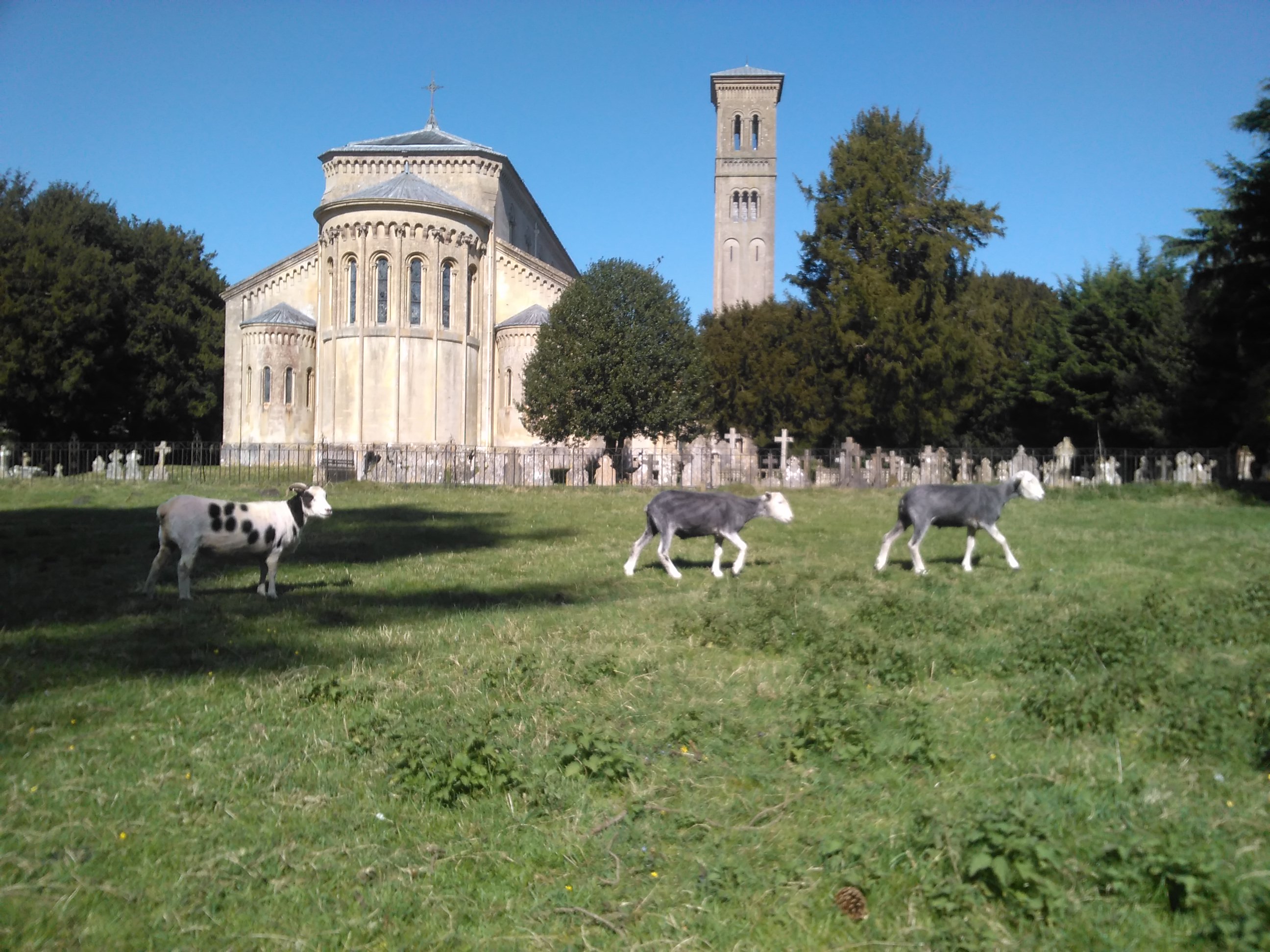
church sheep

And when, a couple of years ago, my family first acquired sheep – as pets and natural lawnmowers, rather than livestock – I was really pleased to discover that they did respond to MY voice.
I could stand at the edge of the top field, just behind the church, and call them – and they would gallop round from the lower field to meet me.
Blissful – at least until the realisation a couple of week later, that exactly the SAME effect could be achieved simply by rattling the feed bucket: it wasn’t so much that “my sheep hear my voice” as ALL sheep like eating, and my presence had come to symbolise feeding time!
Ah well.

In this passage from St John, it’s important to note that Jesus does NOT identify with the shepherd – that saying comes a few verses later.
Here he says, “I am the gate for the sheep” – which doesn’t immediately seem that attractive – barely one step up, perhaps, from being the doormat.
But what is the gate actually for?
It is there, of course, to keep the sheep safe – to keep out any bandits or wilds animals – but, significantly, is also the safe way out of the fold.
The sheep will sometimes need to leave their enclosure, in order to find fresh, and more abundant grazing. And that brings both opportunity and potential danger, they need to be guided in the right direction – and so, the gate keeps them firmly penned in, until the shepherd arrives, and leads them “along right paths”, to the places where pasture is lush but predators scarce.
Jesus the gate then, just as much as Jesus the Good Shepherd, represents the safe and trusted way – out of confinement and out into an abundance of life.

Unsurprisingly, I found a certain resonance in that imagery with our own situation just now: here we are, mostly, locked away in safety – our own front doors providing the same barrier to keep out the unseen dangers of COVID 19.
And yet we too know that we must as some stage look beyond that barrier – and step out into the world again, if we are going to have any hint of abundant life.
And so, if we dwell on these things, we are forced to consider “who NOW do we trust?” – to lead us safely out again?
Whose judgement to we trust to release us at the right time, and in the right way?
How do we restrain ourselves from rushing out like giddy sheep, straight into the jaws of danger?
It’s not easy to know whose voice to trust – especially when it’s not clear what motivates the speakers concerned.
Worth noting perhaps, that not all those now advocating a swift relaxation of restrictions will have your or my best interests at heart.
And equally, not every hard-nosed objection to any such relaxations are necessarily well judged.
Whatever steps are taken in the coming weeks, to enable businesses and other organisations to function more normally, I hope and pray that we will not lose sight of the need to both what is best for us all, and what is necessary to protect the most vulnerable.
The sheep gate isn’t flung open just as soon as the shepherd has appeared on the horizon.
The good shepherd doesn’t just lead the strongest and most valuable sheep to safety.
Of course, regulation changes are beyond our control, but we can at least take responsibility for our own actions in the way we respond.

And while we’re pondering whose voice we think most trustworthy, perhaps we can discern similar truths about ourselves … if it’s not stretching the sheep-fold imagery too far!
If Jesus will us life in abundance – then can we begin to search for that fullness of life right here, at home?
Are there things about ourselves that we keep safely hidden inside us, in order to protect ourselves – whether from judgement or rejection by others – or from admitting to ourselves our own failings or weaknesses?
Can we now face up to those things – accepting ourselves fully and honestly – so that we can then engage MORE fully and honestly with “the world outside”, or at least with our friends and neighbours .. the rest of our “flock”?

Carved round the Font in our cathedral are words from Isaiah 43, which are often spoken at Confirmation services: Thus says the Lord: “I have called you by name, you are mine.”
God already knows us – better than we know ourselves.
There is no use trying to hide from him our weaknesses or frustrations. There’s no use trying to pretend we are anything other than ourselves.
Yet Christ waits still to lead us beyond what WE already know – the new life of Easter is not just his rising from death, it is about US learning to live abundantly with whatever we have; learning to see beyond our own doubts and insecurities, and trusting that there is more to life for us; learning to see beyond our own interests, and trusting that there can indeed be abundance of life for all people, not just the confident and strong.
In the earliest days of the Church, we heard in our first reading, many were baptized, and added to the community, largely because of the quality of that shared life – of the concern shown towards those in need.
Is that the lesson Christ is now calling us to learn – outside the spiritual safety of our familiar Sunday services?
Are we being challenged to rediscover what really marks us out as Christians, and to step up to the mark?

Time will tell, but our starting point in all this is to be ready at the gate – listening for the voice of Christ – and ready to follow him, before all else.

Easter Day

The Rt Revd Richard Chartres

Gospel Reading: John XX.11-18

Christ is risen. He is risen indeed!

ON the Day of Resurrection, Mary had been drawn to the tomb, the place of death. The tomb was empty and no one, in ancient times, disputed that it was empty, although there were various theories about why it was so. Mary was weeping: “they have taken away my Lord”. She was looking towards the past at blessed hours spent in the company of Jesus, and at all the hopes that had perished on the cross.

But then she turned round. She turned in a different direction. In John’s Gospel, every movement is significant. By the time he had composed his account of Jesus’s life, death and resurrection, John had been meditating for many years on the meaning of these events. By narrating them again and again, inspired by the Holy Spirit, he had penetrated the surface of the story and uncovered the depths. Mary turned round and “saw Jesus standing there, but she did not know that it was Jesus”.

The resurrection event obviously did not involve some resuscitated corpse, like the body of Jesus’s friend Lazarus that emerged after four days in the tomb. The raising of Lazarus is the climax in John’s account of the signs which Jesus performed during his earthly ministry. The Resurrection is significantly different. It is not the restoration of an old world or the resuscitation of a corpse but the breaking-in of something new.

Jesus asks Mary, “why are you weeping –- for whom are you looking?” There are various themes in John’s gospel which are repeated and developed, much like music. The very first words we hear from Jesus are addressed to the men who would become his first disciples: “What are you looking for?” Now, in this conversation with Mary, we see that the truth we are seeking is not so much ideas in the mind but rather what we discover in relationship with a person. “Who are we looking for?”

He calls her Mary. God “calls [us] by name”, as it says in the Confirmation service. By naming Mary, he opens her eyes and she turns once again.

Her eyes are open, but not fully, because she then calls him “Rabbouni”, an affectionate diminutive of rabbi — teacher. It is a word from the old life, and Jesus asks her not to cling to him as he was, because Resurrection brings into being a new reality. It is not any resuscitation of the old life. It is an earthquake, a new creation.

This new reality explains the transformation of the friends of Jesus. They had been so full of fear when he was arrested that they had all forsaken him and fled. After the resurrection, they were transformed into a world-converting community. After the empty tomb and the appearances of the transformed body, they were prepared to defy death rather than deny the truth of what they had witnessed.

In our day, we tend to ask questions about the resurrection as if it were simply a past event. Even if someone had taken a photograph of the actual moment, it is part of the “flatland” thinking that is second nature to us, only to be able to regard the resurrection as something past and separate from us. At best, we translate it into some inoffensive metaphor describing an inner emotional state in which winter gives way to spring.

In divine reality, of course, the world of individual bodies and separate events is embedded in a vast continuum in which body, mind and soul are interpenetrated by the Eternal Spirit. What God creates is not destroyed but is re-created and transformed.

The message that Mary was to communicate to the other friends of Jesus is, “Say to my brethren that I ascend to my Father and your Father and my God and your God”.

The earthquake of the resurrection opened a fissure in earth-time through which God’s future could stream into the world. We can be a part of this future by water and the spirit; being immersed in his death in baptism, and receiving the gift of the Spirit.  In the Spirit, which makes the risen Christ present to us, which reveals the truth in a person –- the human face of God — we discover that life in all its fullness comes not as we hoard up ourselves and set our hopes of happiness on accumulating things but when, in the power of his Spirit, we give up ourselves to one another and so bring into being a new world of possibility.

God so loved the world that he was generous and gave himself to us in the person of his human face, Jesus. Love for God is not so much an emotion as self-giving and generosity. Self-giving in the power of the Spirit is transformative.  This has been proved experientially in the lives of the saints, those who — as St Peter said – “did eat and drink with him after he rose from the dead”.

The day of resurrection has dawned, even as we practise social distancing in our own private spaces. It is accomplished. But the resurrection itself is also happening, and the resurrection is full of future hope in a world where we have only just begun to learn how to speak the language of humanity as God intends.

Being a Christian is not buying into a package of ideas about God; it is not signing up as a member of the churchy equivalent of the National Trust to preserve the memory of Jesus. It is immersing oneself in the power of the Spirit in a new creation.

Being a baptised and confirmed Christian means entering a new set of relationships in a transforming community, empowered and energized by the Holy Spirit, who is at work bringing into being the future that God intends.

This morning, as we are locked down in our virtual Galilees, we are all being called to be lively members of God’s transforming community. We are to be ready to spring from our locked rooms at a time of great promise and peril. Our very complex world is menaced by natural disaster and lethal hatred masquerading under the mask of religion. Alone, we can feel immobilized. What can we do against such huge threats? But as members of the spirit-filled, transforming community that the church is called to be, there is nothing that is impossible as we work together to enlarge that fissure through which God’s future is streaming.

As we cherish one another, making one another our work of art without oppressing anyone with our demands; as we own up to our weaknesses and needs, we begin to participate in the great dynamic of the love which is eternally exchanged between the Father and the Son through the Spirit. We become seized by invincible hope.

This morning we are not entertaining some idea but participating in a living reality. Alleluia! Christ is risen. He is risen indeed!