Author Archives: mands2015
Autumn Newsletter
Summer Newsletter
Click on link above, for latest edition of Wilton Parish News.
Annual Report 2017
ANNUAL REPORT 2017
When planning activities for the year, the incumbent and PCC have considered the Commission’s guidance on public benefit and the specific guidance on charities for the advancement of religion.
We strive to enable parishioners to explore and develop their spiritual awareness and to live out their faith, by means of prayer and worship, Bible study and ethical discussion, and provision of pastoral care to all sections of the community.
The work of all three churches is summarised on the parish website, http://www.wiltonparish.co.uk..
The PCC aims to provide public worship appropriate to the varied needs of the inhabitants of the Ecclesiastical Parish.
Where practical this includes ecumenical cooperation with the local Baptist congregation and members of other Christian denominations living in Wilton.
The clergy seek to respond to all requests for the “Occasional offices” of the Church – Baptisms, Marriages and Funerals from those living in the Ecclesiastical parish, or with a legitimate connection with any of our churches and to provide appropriate preparation and pastoral care.
We seek to foster a sense of community within the town of Wilton through the provision of social activities and active involvement in other local organisations.
To facilitate this work, we strive to maintain the fabric of our church buildings and meeting room in good order – taking due note of the recommendations included in our Quinquennial Inspections.
In December 2009 it was agreed that the PCC would discontinue its policy of making annual grants to specific charities and would instead encourage individual Church-members to support such charities as far as they are able. In addition, the PCC nominates a monthly/quarterly Charity – for which donations are invited at Coffee after the principal Eucharist each Sunday – with a balance of local, national and international charities. In addition Wilton’s congregations continue to sponsor the education of Richnaider Paul, in Haiti – through the Charity “SOS Children’s Villages” and, through Chalke Deanery, agricultural and social projects in the Diocese of Cueibet, South Sudan.
The PCC makes provision for regular public worship in all three churches, as well as a Trust-owned Chapel in Wilton.
At the Parish Church, Morning Prayer was said Monday – Saturday and on Sundays either one or two celebrations of the Eucharist have been held.
At St. Peter’s Church, Fugglestone, regular services were suspended from the end of September 2013 due to lack of heating and lighting. Thursday morning Communion services were introduced in 2016 and these were continued in 2017, along with occasional Evening services. These attracted a small but committed congregation, including some of the new residents of the “Wilton Hill” development.
At St Catherine’s Church, Netherhampton weekly morning services were held – alternating between Holy Communion and Matins. The Congregation were saddened by the death, in April, 2017, of The Revd Sue Porter, who had continued to lead services until the previous month. Canon Stella Collins and Revd Ronald Broadbent, who had previously assisted at St. Catherine’s, also died in 2017.
Parish Clergy continued to be assisted by two Lay Worship Leaders, Christine Lawson and Tim Purchase, and by the retired clergy – notably Canon Chris Savage and Canon Michael Goater.
The Revd. Janet Mugridge continued to play a significant role at St. John’s Priory and to assist at the Parish Church.
In July, The Revd. Caroline Titley was Ordained Deacon and licensed as Assistant Curate – working in the Parish on three days per work plus Sundays.
In our aim of drawing parishioners, and others, to God through worship
we have again benefitted enormously from the commitment of our Parish Choir, Organists, Ringers, Verger and Altar servers, Eucharistic Assistants, Lectors and Intercessors and have been very well supported by our Churchwardens, Sacristans, Flower Arrangers and team of sidesmen and women – all of whom show admirable dedication.
Two Mothers’ Union Groups and the men’s group, “Grapevine”, continued to meet regularly, as did the Bible Reading group established in 2016. A Study course on “Worship” and a successful Lent Course were also held. In the Autumn, two separate evening groups were established – using material from “The Emmaus Course”.
Early in 2017, a decision was taken to move the Tuesday morning “Coffee Corner”, from the Parish Church to the Community Centre – which was felt to be warmer and safer for young children at play, and also provided opportunity to use the enclosed outdoor garden. Attendance proved variable, but a good number of children and carers visited during the year.
The Ecumenical “Open the Book” team continued to meet in the Primary School, on alternate Mondays, to present dramatised Bible Stories and engaging the pupils and staff in various ways.
The Parish’s Safeguarding policy was re-adopted, pending revision in line with changing Legislation and the 2016 Health and Safety Policy retained.
In March the first “Triennial Inspection” was conducted by the Archdeacon of Sarum, Ven. Alan Jeans, resulting in only minor recommendations and a requirement for updating of Graveyard plans and a proper legal agreement for the leasing of land adjacent to 29 West Street, Wilton.
In January the Parish Church hosted a meeting of the Deanery “Pulse Camp” – attended by 19 young people aged 11 – 17 from various Christian denominations. The summer camp in July was held in a new location – the Hampshire Christian Trust, at Lockerly – in order to cater for larger numbers of young people, with over 70 attendees, including 6 from Wilton Parish Church.
A change in Deanery personnel, and also the increase in scale, prompted a request to bring the Pulse Camp accounts under the control of Wilton Parish.
The PCC agreed in principle, subject to the Parish Treasurer’s approval, after seeing the “Pulse” accounts.
“The Hermitage Ensemble” – singers from St. Petersburg – returned to the Parish Church in March for a concert of Sacred and Secular music, attracting a large audience and staying overnight with members of the congregation.
In April, the Parish Church hosted the Salisbury Branch of the Prayer Book Society, for their AGM and Evensong.
The Parish Church was closed/partially closed for a number of weeks in April and May as urgent Electrical repairs and (unexpected) emergency repairs to the gas main and flooring were undertaken.
In May, the Bishop of Ramsbury, Rt. Revd. Dr. Edward Condry, presided at a service of Confirmation in the Parish Church. 5 adults and 8 young people from our own congregation were Confirmed – the largest group for 25 years.
Also in May, the Parish Church hosted the “Visitation Service” at which more than a hundred Churchwardens were commissioned for the following year. As well as the warmth of welcome, the Archdeacon commented on the quality of the organist and choir and thanked them for their contribution.
The Archdeacon returned in July, to Commission our two Lay Worship Leaders, and also in October to lead the Principal Eucharist for the Feast of Christ the King.
Services for Holy Week and Easter followed the comprehensive pattern established in 2015, following a major review. These were well attended, as was the Ecumenical “walk of witness” on Good Friday, although it was again noted that many regular members of the Congregation were away for the holidays, leaving the remaining core to minister to a large number of visitors.
In early September all three of our Churches welcomed participants in the Wiltshire Historic Churches Ride and Stride.
Mid-September brought a visit from Glass Specialist, Pascale Lemaitre, from Paris – recording detail from the windows in the Parish Church’s main Apse – in the hope of recreating some of the panels originally from the Basilica of Saint-Denis.
Parish Share continued to pose a serious challenge to the mission and ministry of the local church. After the annual APCM four parishioners volunteered to form a “Finance Group” to scrutinise Diocesan Spending and the fairness of what parishes were being asked to find. The PCC recognised the need for ongoing promotion of Stewardship matters and also the need to press for the greatest possible clarity and accountability in Diocesan and National Church Budgets.
More happily the Treasurer announced that Wilton Church had been left a generous bequest of £160,000 – from the estate of the late Gwen Filbee – which, subject to certain “provisos”, could provide valuable opportunities to strengthen the PCC’s work.
Pastoral Offices
In 2017, parish clergy officiated at 19 baptisms, 12 weddings and 17 funerals.
(In 2016 – 25 baptisms, 9 weddings and 8 funerals.)
Community
Members of all three churches are involved in other community groups and organisations – including Wilton Community Centre, Public Library, Burnbake Trust, Alabaré, Riding for the Disabled and also assist with events such as the Christmas Day lunch for the elderly. A number of church-members are Trustees for almshouses at St John’s Priory and St Giles’ Hospital and for three separate Educational Trusts. In addition to the Rector, the Parish Church provided two Foundation Governors and two other Governors at Wilton and Barford School.
As Trustees of the Wilton Middle School Educational Trust, the Rector and Churchwardens contributed further significant grants to local schools, the Youth Centre in Wilton, Youth Action Wiltshire (for work with Young Carers) and provided assistance to one mature Student in financial difficulty. The Rector continued to attend monthly meetings of the Wilton “Town Team” and to represent Wilton at Area Board “Youth Network” meetings.
Educational visits to and services in both the Parish Church and St Catherine’s Church have been arranged – with the local Primary schools and nursery schools and with the local “uniformed youth organisations”.
A steady flow of tourists and pilgrims visited throughout much of the year, although the disruption of closure I the early Summer proved disruptive – not least for the dedicated group of “church guides”.
In April the District Scouts Association again held their annual St. George’s Day Parade and Service at Wilton. Attendance was lower than in 2016, due to the fact that St George’s Day fell during school holidays. Around 300 participants joined in the Parade and Service, followed by a bonfire, picnic and games on the Rectory Meadow.
The Parish Church’s Summer Festival was replaced by a three-day Flower Festival, celebrating 40 Years of the Bemerton Flower Group.
Wilton’s “Mayor’s Sunday” was held on 17th September, the nearest Sunday to St Edith’s Day,
Remembrance services were well attended in both St. Catherine’s and the Parish Church, and a sizeable congregation gathered at the War memorial on Armistice Day for a short Act of Remembrance.
An appeal to villagers, ahead of St. Catherine’s Patronal Service in November, elicited a generous response of around £6,000.
Wilton’s annual “lighting of the Christmas Tree and children’s Nativity” provided further opportunities for ecumenical cooperation and for partnership with other Town Team organisations. New costumes were provided by donations from the Order of Foresters and the Wilton Christian Fellowship, enabling a far larger “cast” to be drawn from the Primary School.
The County Carol Service was held in the Parish Church, on St. Nicholas’ Day (6th December) – with the Bishop of Salisbury as preacher and a large and appreciative congregation.
In the Rector’s absence, the Curate and Baptist Pastor officiated at the annual Carol Service for the Pembroke Centre (Riding for the Disabled).
The Primary School Carol Service, in the Parish Church, marked not only the end of term but the end of the Jan Nock’s ten years as Head, and also of Claire Rendall’s time as RE coordinator and Worship leader. The service was prepared and delivered by staff and pupils.
The Christmas Fayre was again held in the Community Centre, with a similar format to previous years. Despite a cold start to the day, attendance was good – thanks in part to church-members delivering “flyers” to local residents, and to the offer of transport to elderly residents living along The Avenue – thanks to the loan of the Scouts’ minibus.
An ecumenical group of Carol Singers serenaded residents at Olivier Place and discussions ensured about the possibility of further events in the communal area.
“Welcome” leaflets were delivered to all new houses and apartments before Easter.
For the second time in 18 months the Editor of the Parish news stepped down with no obvious successor. It was decided at the November PCC to discontinue the “magazine” format and to produce a slimmer “Newsletter” which could be produced more easily and more cheaply. It was further agreed that this would be delivered free to all households in the parish on a quarterly basis.
Buildings
St. Mary and St. Nicholas’ Church:
The Town Council continued to arrange the grass cutting, and other aspects of the churchyard continued to be maintained to a high standard, largely due to the efforts of Nick Barsby, Neill O’Connor and David Fraser.
A Large Corsican Pine tree, which had been struck by lightning in 2016, was deemed to be unsafe. This was reduced in November to leave a 20 foot “monolith”.
Two local craftsmen were entrusted with salvaging some of the wood taken down with the aim of producing objects for sale in due course.
A feasibility study was also undertaken as to whether the church’s current lighting system could be adapted to house LED bulbs throughout. In December two sample fittings were trialled and the electrician was asked to draw up detailed specifications for the Archdeacon’s approval.
St. Catherine’s Church
A new 3-phase electrical supply was installed and heaters were replaced.
The War Graves’ Commission identified two graves in the Churchyard and asked to install a commemorative plaque.
St. Peter’s Church
The heating was overhauled and certified safe for use, enabling services to be held during a greater portion of the year.
The lighting remains unsafe to use, however, and awaits further restoration of the building.
The churchyard continues to be maintained – with the assistance of Andy Hogan – and remains open for burials.
Snow Vision
Sermon preached on 4th March 2018
This morning I’m going to speak about “snowflakes” – both the literal kind, that clump to gather to turn our world white, and the human kind – “snowflakes” in the modern sense of people who can’t stand any criticism, or even being exposed to strong views with which they disagree, who need to be warned in advance if a particular talk or film might contain themes of an upsetting nature.
I’m not sure who first used the term “snowflake” to apply to a person – or quite what they had in mind – but there are perhaps two ways in which human and “literal” snowflakes are similar – just one strong blast of heat and they simply dissolve; and, clump enough of them together and they can very effectively distort reality.
Beginning then with actual, fluffy white bits of snow, and on Wednesday morning I heard a new phrase on the weather forecaster when the presenter spoke of a pestering of snowflakes”. I’ve heard phrases before like “persistent rainfall”, but a “pestering of snowflakes” had a slightly poetic ring to it.
Over the next two days, of course, much of the country has seen rather more than a pestering of snowflakes – with heavy falls and drifts of snow in many places.
And it’s remarkable how quickly the landscape changes. From the warmth of our homes, looking out – the pristine white that covers the ground can seem very beautiful, adding a brightness to the sky, after weeks of soggy greyness, and bringing our surroundings into sharper focus – making everything seem fresh and clean.
Out in the countryside, however, the snow-covered landscape can feel rather bleak – threatening even.
It’s often no longer easy to tell where the road surface ends and the roadside ditch begins.
One wrong turn and you find yourself well and truly stuck, and feeling a long way from any human help.
And it seems to me that the snow-laden experience of the past few days provides us with a good image for Lent.
This is the time when we are called to change the “landscape” of our own lives, just as Jesus took himself into the wilderness – enduring heat rather than bitter cold – away from familiar routines, familiar faces, away from his usual means of support.
During Lent we are meant to echo that wilderness experience to some extent, in order to bring into sharper focus our lives and our dependency on God, rather than the frills and distractions of human society.
For me, not being able to wander off somewhere for 6 weeks, the only way of refocussing that I could think of was to limit my reliance on technology – and I decided not to check emails either before 9am or after 9pm: to spend half of each 24 hours ignoring the annoying ping on the phone and keeping my attention on something else instead.
The effects of that MAY be that some of you will wait slightly longer for a response to your messages – but it also means, hopefully, that when you do hear from me it will be better thought out and at a more social hour.
For me, not being in thrall to the email means beginning the day with a little more time for the things I’d normally rush through without thinking, and ending the day without quite so many ideas jumbling around in my brain.
I think I might just keep this up when Lent is over!
Part of our “collective refocussing” here, each Lent, is the installation of the Stations of the Cross – I never get used to how different the church feels the first time I walk in and see them each Lent.
Like the snowfall, they change feel of our surroundings – perhaps making our church seem even more Italianate.
Those symbols of Christ’s passion – of the Way of the Cross – help to point us beyond the noticeboards and notices of our activities – and to remind us of Christ’s presence in his temple.
And, again like the snowfall, those stations can appear both beautiful and also rather stark
– a reminder of Jesus’ very real pain and death
– a reminder that Jesus knew the bleakness of isolation, feeling very far from human help,
despite the pressing crowds all around him.
The seriousness of Lent, and the starkness of those Stations, point us to what we heard in our first reading -that “the Power of God is Christ Crucified” – a notion which the author himself suggests is a “foolish” one from a worldly perspective.
But I would interpret that as saying that Christians should not be “snowflakes” – in the sense of overly-fragile people.
We should not expect to experience God’s power as a means of keeping us always safe – cushioning us from the harsher realities of life, or as a hiding place from anything that might upset us. (Jesus himself was not spared suffering and distress.)
The power of God is revealed most clearly precisely when we do face hardship and challenges, but then, by God’s grace, find that we can work through those difficulties, and emerge from them with new energy and insight.
To stretch the analogy a little further –
we appreciate the warmth of the sun far more powerfully when we are thawing out after a cold spell,
than when its heat is constant at the height of summer:
it’s in the transforming process – in the changing of the seasons – in the healing of broken hearts and minds – that God’s power is most vividly displayed.
During Lent, then, yes – we are called to look beyond some of the ordinary, everyday things that clutter our lives – in order to focus our minds more clearly on seeking God, and his ways.
And yet, we need to be careful that doesn’t become an escape into fantasy.
Lent isn’t just about making ourselves feel virtuous, or hiding away in some private sanctuary of holiness. Nor should we clump together, like snowflakes, to disguise the realities of life under a false covering of perfection.
If we are serious about seeking God – we shouldn’t be surprised if what we find challenges us, rather than consoles – just as Jesus challenged the temple traders who seemed to have lost sight of what their Temple was really for.
God, whose wisdom and power is revealed through Christ crucified, calls us into the dark places – calls us to notice what is wrong in the world around us – and to use our faith to do something about it.
In the last few days, we’ve heard of some heart-warming acts of kindness – from 4 x 4 drivers getting through urgent supplies and stranded workers; the determination of medical staff walking miles to and from work each day; the Greggs delivery man giving out cakes to motorists stranded on the motorway with him.
It’s that same generosity, that same awareness of other people and of our responsibility to and for each other, that God challenges us to find in more usual circumstances.
Let us pray then, this Lent,
that the vision of Christ crucified might teach us
to see more clearly the needs of the people around us,
and honestly to acknowledge our own needs,
and, in the power of God, to find the resources we need to bring about the transformation that he wills for us all.
Parish News – Spring 18
The silent “bells” of Candlemas
Homily – for the Feast of Candlemas ( celebrated on 28th January 2018)
Today we celebrate the Feast of the Presentation of Christ in the Temple – Candlemas – and, right on cue, all around us we can we can see the first flowers of the new season – the snowdrops, also known as Candlemas Bells.
And those tiny flowers offer a double-meaning for us – the lush green of the stalks give us a strong hint of the coming Spring, and yet the pure white of the flower-heads is still suggestive of winter snow.
Rather like last Friday’s clear skies – which brought both sunshine AND lower temperatures – Candlemas Bells, like the feast itself, offer us a mixture of hopeful expectation but also a warning to be ready for harder things still to come.
Our service, this morning, reflects that mixture of thoughts and emotions: the comforting glow from our Crib scene has gone, to be replaced by a manger.
And the manger is empty, apart from a folded sheet – symbolising the “bed clothes” which kept warm the infant Christ. And at the end of the service, that same cloth will be refolded and carried to the Cross, as a symbol of Christ’s “grave clothes”, or shroud, and all that lies ahead before Easter.
And so today is a turning point – a refocussing of our spiritual energies – not forgetting the hope-filled expectation of Christmas, but making ourselves ready for the purposeful observance of Lent, just over 2 weeks away.
Today is also a reminder of our Jewish heritage.
Mary comes to the Temple as a good Jewish mother – to present her first born son, – and to be purified, to be declared ritually clean again after her child-birth.
And IF that now seems an odd idea to us – in the 20th century it would have been less strange: you only have to look at the Book of Common Prayer – our church’s main service book until the end of the 1950s – to find an order of service for the “Churching of Women”. And, although, the emphasis there is clearly on giving thanks for a safe delivery, the mother is still expected, as Mary was, to make an offering as she is welcomed back into the worshipping community.
We shouldn’t be surprised, then, to find echoes of Jewish worship and practice within our own traditions: the Hebrew Scriptures form by far the larger part of the Christian Bible, the earliest Christians still worshipped in the synagogue, the patriarchs of Judaism and Christianity are one and the same.
Clearly, we ourselves are not Jews – but, as followers of Jesus Christ, neither can we be completely un-Jewish – still less anti-Jewish.
It’s with an extra poignancy, then, that we find ourselves marking this Feast just one day after Holocaust Memorial Day – recalling more recent history and the systematic isolation and persecution of European Jews at the time of the Second World War.
And, as we know, that is not the only time that Jewish communities have found themselves unwanted or made scapegoats within predominantly Christian countries.
Perhaps this most Jewish of Christian feasts can remind us of our shared heritage, and strengthen our resolve never again to allow the demonization of any race or religion.
At a time when relationships between the Abrahamic faiths – Judaism, Christianity and Islam – are somewhat tense, at a time when nationalism and “populist movements” seem to be on the rise – it is as important as ever to assert that we are all children of the one, true God, by whatever name we call him and however we perceive or worship him..
Our oldest Prayer Book contains the Jewish inspired Churching of Women, and our newest prayer book – Common Worship – contains this Jewish Prayer of mourning, the Kaddish, which is in effect a prayer for peace:
Blessed, praised and glorified, exalted , extolled and honoured, magnified and lauded be the name of the Holy One; blessed be God for ever.
Though he be high above all blessings and hymns, praises and consolations, which are uttered in the world; blessed be God for ever.
May there be abundant peace from heaven, and life for us and for all people; and let us say Amen.
“The Word”, and other words at Christmas!
Sermon preached at Midnight Mass, 24 December 2017
This is perhaps the most dangerous sermon of the year –
dangerous, at least, in the sense that there is an increased risk that by the end, at least some of the congregation will have nodded off to sleep! So let me start by telling you something of what’s in it just in case.. Tonight I want to talk about “Youthquakes”, Bitcoins and bottle deposits. And if you want to know how on earth I can connect all those things into Christmas – you’ll just have to stay awake!
Let’s start then with “youthquake”, the Oxford Dictionaries’ Word of the Year. Youthquake is defined as ‘a significant cultural, political, or social change arising from the actions or influence of young people’. We might think of the huge social changes that occurred in the 1960s – and whether we view those changes as good, bad or indifferent probably depends on how old we were at the time or, as in my case, if we’re not old enough to remember!
The same generational fault-lines surfaced again during this year’s General Election – which perhaps explains why a word that most of us hadn’t ever used until very recently has suddenly shot to prominence.
Perhaps the most predictable link to the Christmas story, then, lies in the fact that Jesus – God incarnate – comes to us not as a mighty warrior – not even as a stroppy teenager – but as a tiny, frail infant – unable to speak, let alone command his people to repent. And yet, if this story of Christmas is true, then this tiny child has sent shockwaves through not just one society, or culture, but through the whole created cosmos.
This tiny, helpless baby grew to become – yes the awkward adolescent, giving his mother more than the odd palpitation along the way, and then the charismatic leader – unafraid to challenge the failings of the society he lived in – willing to die to prove the point of God’s greater plan for us all.
I said “if it is true” – because it is painfully obvious to us all that the world we live in today is far from perfect – it is painfully obvious to those of us who believe that many of our neighbours are pretty indifferent to Christ and his gospel most, if not all, of the time.
How are we supposed to make sense of that? Was the world changed for ever by this particular “youthquake” or, as our detractors might suggest, is it the case that we have been left behind as the world has moved on again?
Cue the “bitcoin”!
That’s another word about which we’ve heard plenty over the last couple of weeks – along with terms like “cryptocurrency” and “futures markets” – neither of which tend to crop up in most people’s daily conversation.
As the new currency was released, last month, one financial commentator was asked to speculate on how the Bitcoin might be performing in 20 years’ time. The answer she gave was very succinct – “it will either have petered out altogether or it will have completely changed the way the world works”.
The reason for that bold claim is that this is the first widely available currency that has no central bank or administrator – relying completely on transactions between users, of which there are estimated to be as many as 5.8 million users (but no-one is exactly sure!).
It is a very different way of operating – outside the control of the established systems – and just as unsettling to some in financial services as any cultural “youthquake”.
And the relevance to the Christmas story, perhaps, is this: that there is no reason, just because most people don’t yet understand the Bitcoin or “zone out” whenever it is discussed, to assume it is not important. In 20 years’ time it may well have changed the way the world works beyond all recognition.
Just think of how much the way pay for our shopping has changed in the last 20 years.
Just because most people don’t understand much about our faith, or chose not to bother with it – there is no reason to assume that it isn’t true – nor does it undermine the belief that Christ has transformed the world, even if it takes a lifetime to explore the new depths of truth that are being revealed for us.
As G.K Chesterton commented, a century ago,
“Christianity has not been tried, and found wanting; it has been found difficult and not tried.”
The indifference of others should not deter us from the light of truth which shines among us this night.
And so to “bottle deposits”.
I am old enough to remember carrying empty “pop bottles” – lemonade bottles – back to the Coop and being rewarded with a few pence to spend at the neighbouring newsagents.
This week proposals have emerged for a new system of deposits – this time on plastic bottles. And there may well be rewards and penalties for manufcturers – corresponding to the ease with which their packaging can be recycled.
All this comes on the back of the recent “Blue Planet” series –presented by David Attenborough, and examining the state of the world’s oceans and the damage done to them by our pollution – and specifically plastics.
Towards the end of the series Attenborough commented that we can now “see, more clearly than ever before”, the effects our collective lifestyle is having on the oceans and the various life forms that depend on them. And he mixes an optimism that, with determination and cooperation, we can reverse the damage relatively quickly, with a palpable frustration that people and governments seem unwilling to act – unwilling to believe what they can now see with their own eyes – preferring to carry on as before.
Again – there’s a resonance with the Christmas story.
As we heard, from the beginning of the Gospel of John, Jesus came into the world but
“his own people did not accept him”.
And later, in Chapter 3 we read that “people loved the darkness rather than the light … for all who do evil hate the light and do not come to the light, so that their deeds may not be exposed.”
Clearly, it’s not a new problem then!
Simply showing people the reality of any situation will not convince them to act.
None of us like to face up to the fact that we are part of a problem
and may need to mend our ways.
But that, it seems, is exactly what we need to do – according to David Attenborough – if there is to be life on earth in the future.
That is exactly what we need to do, according the Gospel –
if we are to realise the vision of eternal life for which God created us.
Christ calls us to resist the temptation to hide ourselves away from the light – denying the uncomfortable truths we see – and, instead, to look up and see all that he makes plain for us, to look within ourselves, to look around us
and to act on what we see.
That calling is powerfully expressed in the Baptism service, when each new Christian is greeted with these words:
“You have received the light of Christ.
Walk in this light all the days of your life.
Shine as a light in the world to the glory of God the Father”.
May Christ give us grace, this night,
to acknowledge our Christian calling –
to know ourselves to be “children of God”;
to live our lives in the light of his truth;
and to testify to his presence in the world
– that others might believe through us.
Amen.
Taking a “pop” at the Poppy?
12th November 2017
Parade and Service of Remembrance
Every community has its natural “gossip points” – places where local information is exchanged and where the latest innovations and scandals can be shared and argued over at leisure. Here, depending on our age and personal taste, that may well be The Bear, or one of the many local Coffee Shops, among one of the groups that meet at the Community Centre; it might be on the top deck of the of the bus to school or perhaps even in “Sprinkles”, in town, when you’ve missed the bus home! One way or another, we tend to find our own sources and outlets of local intelligence – reliable or otherwise!
For me, one of those places is Wilton Barber Shop – although, sadly, I don’t need to visit quite so often these days! But when I do, I’m always confident that some interesting snippets will emerge in the conversation and that strong views will be freely expressed!
This week, the talk was about poppies – and the increasing reluctance of many people to wear them. For around 11% of the population, it seems, that reluctance is due to a concern that wearing the poppy – and attending commemorations like this one – actually glorifies war.
Some of those in the Barber’s were quite angry about that suggestion – seeing it just as a selfish excuse for not joining in and honouring those who fought for our freedom.
I have to admit I just feel rather weary with the same circle of arguments that seems to surface every now and then: and, rather than fuelling the conflict of ideas that is buzzing away just now, I think we should all simply get on and observe Remembrance with integrity – with a careful balance of pride and regret.
The Poppy is a symbol like any other – to which we can attach positive associations or negative ones – it’s up to each one of us what we make of that symbol.
The poppy CAN glorify war if want it to, it CAN say more about those who wear it than about those who died, if we let it – but it doesn’t need to.
We know that our national flags – the Union Flag and the St George Cross – have been appropriated by the Far Right as symbols of their distorted nationalist pride. But rather than abandon those emblems, because they CAN be misrepresented, we would surely do better to reclaim them by offering a better interpretation of civic pride and national identity.
The Union flag preceded this morning’s Parade – of youth organisations and Councillors – and, back on St George’s day, as several hundred Scouts made their way into this Parish Church, it was behind both national flags – not as assertions of nationalist aggression, but of solidarity with each other and our patron saint.
Poppies, like national flags, CAN point to a narrow, triumphalist vision of national insularity and nostalgia – or they can represent a broad vision of shared national values and of continuity between the generations.
We should, I think, wear our poppies with pride – as the slogan went – and also with a tinge of regret.
And if we really do need a corrective against the glorification of war, then it’s in the very act of Remembrance – of remembering the grisly reality of past wars and present conflicts that we’re most likely to find it.
It’s a very sobering thought that, among those Scouts who paraded back in April, were young men who, had they lived in 1917, would have been wearing a different uniform and worrying not about A levels and acne, but about the much starker challenges of the trenches.
This year marks the centenary of one of the bloodiest battles of WW1 – the “Third Battle of Ypres” – which raged from July to November 1917, culminating if the capture of the village of “Passchendaele” – the other name often given to this conflict. 1917 was the wettest summer for 40 years – and Passchedaele stands out in the history of WW1 not only for the huge loss of life – around ¼ million casualties on both sides – but also the dreadful conditions in which the men fought – sometimes described as a man-made swamp.
Recalling the loss of so many young lives and the lost potential of that generation is very far from “glorification”.
It is, in fact, a reminder that war really is only a last resort – that war is itself a sign of failure – necessary only when political will and diplomacy have proved inadequate.
The point of Remembrance services, the point of wearing poppies is precisely that – is the regretful admission that war is sometimes necessary, in order to defend what we perceive to be right and good, but never desirable.
If we wear our poppies with pride – it is in recognition and gratitude that when the need did arise – there were so many who were willing to put the needs of their country ahead of their own personal ambitions.
Perhaps not all of them knew what they were letting themselves in for – especially back in 1914 some of those young men may well have marched off with unrealistic expectations of a quick skirmish and a return home as conquering heroes – but they were quickly disabused of that notion and the many who followed them did so with grim determination, not jingoistic enthusiasm.
And it’s for that determination, for that personal sacrifice –that we honour them all each year.
In doing so, we’re called to renew our own determination to ensure that we don’t squander the freedoms that they fought for – that we don’t simply pursue our own personal ambitions at the expense of our neighbours – that we are always prepared to do what is necessary to defend and promote what is good and just in the world of our day.
A final thought from the world of football.
I’m not a great soccer fan, as it happens – but it would be hard for any of us to have missed the protest that greeted FIFA’s attempt, last year, to ban the wearing of poppies by players because, it was said, they were a political symbol.
That ban has been lifted, and on Friday poppies were very much in evidence as the national teams of England and Germany faced each other at Wembley Stadium,
with its new statue commemorating the Christmas Day truce of 1914.
Both teams wore black armbands with poppies on them. And before the match began, representatives of the Army, Navy and Air Force of both nations laid wreaths and players and fans of both nations kept a respectful silence in honour of all the war dead.
In that moment the poppy became a symbol, not of division, but of reconciliation – and in that united gesture surely there is hope for the future.
Let us continue to wear our poppies then – let us remember – with pride, with sorrow and with hope.
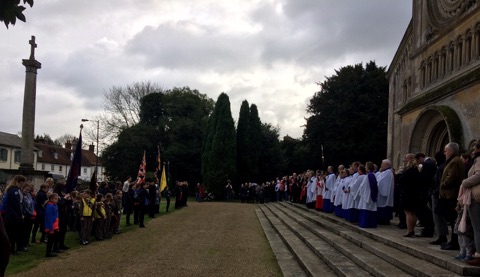
Table Manners!
15 October 2017
(Readings: Philippians 4: 1 – 9 * Matthew 22: 1-14)
Next Wednesday, we celebrate the Feat of St Luke the Evangelist – also known as St Luke the Physician. And so I’d thought I might pick up on that, and on this week’s news items about the shortage of family GP’s and/or the use and overuse of antibiotics, and give you a nice topical sermon this week.
And then I read this morning’s Gospel – and thought I’d better take a look at that instead!
St Luke will get a sideways “look in”, however: he also records this parable in his Gospel – but with some notable differences – and I thought it might be worth just noting those discrepancies, to see what if that might help us make sense of this slightly uncomfortable passage.
Whichever version you read, the central message is not going to be a comforting one for the Pharisees and Jewish leaders who seem to be its intended target: the King invites those whom he assumes will come to the feast and honour his son, only to be sorely disappointed – and so he invites a different set of people to take their place.
The account that Luke gives us is a simple analogy for the way that the Jewish leaders had rejected God’s son: those who saw themselves as God’s people had failed to recognise Jesus as the messiah, therefore God would call a new people who would honour him.
That’s a fairly straightforward message – and, for those who see themselves as part of that second group of people, those early Christians for whom the gospels were first written down, perhaps a reassuring one.
But then Mathew goes and complicates it with further details!
In his account, the intended guests aren’t just rude – ignoring the king’s invitation – they make things far worse by mistreating the slaves who bring their invitations.
Perhaps Matthew adds this in as a reflection of the growing hostility that Jewish Christians were facing from non-Christian Jews: when the Jewish Temple was destroyed, in the year 70, some Christians saw this as a sign that the old order had been destroyed. At the same time some Jewish leaders blamed the Jewish-Christians – seeing this destruction as God’s judgement on their false beliefs.
And so, when Matthew sets down his gospel, it’s against a backdrop of division within the Jewish faith – with those who are followers of Jesus finding themselves less welcome, and eventually being expelled from the synagogues altogether by those who rejected Jesus and his teaching.
Is this what Matthew is reflecting when he describes the mistreatment of the King’s slaves? Are we meant to recognise them as the Jewish Christians – offering the invitation to Christ’s banquet and being persecuted for their troubles?
And then the second “extra” in Matthew’s account seems even harsher – and that’s the poor man without the robe.
It’s really not clear what’s going on here and it’s hard not to feel sorry for this man: he had no idea that he would going to a wedding feast – but has responded to the invitation and turned up anyway. So it feels rather unfair to criticise him, then, for not wearing the correct robe.
The king’s initial civility – “Friend, how did you get in here without a wedding robe?” – can’t disguise the harshness of his punishment he then suffers: “Bind him .. and throw him into the outer darkness.”
So what is that all about? – why couldn’t Matthew just have left things uncomplicated like Luke!?
Presumably the key must lie in the man’s response to the King – or rather his lack of response. It’s almost as if the man doesn’t realise who is speaking to him – that he hasn’t actually bothered to find out whose feast this is, or the reason for it – the marriage of his future king.
He’s simply accepted the offer of free food – without entering into the spirit of the occasion – a gate-crasher rather than a guest. He’s really not that interested in the king’s feelings – or in honouring his son – and it’s for this discourtesy – it seems – that he faces the king’s wrath..
So, with this added twist to the tale, is Matthew perhaps sharpening the divisions within Judaism – emphasising that those who ignore Jesus (the son) will themselves be rejected by his father?
Again, to those early Christians – that would come across more as a message of reassurance – that they WERE on the right track, they were “God’s chosen ones” even if they were facing hostility for their beliefs.
To us that message is rather less immediate and possibly less reassuring – we’re rightly wary of anything that seems to cause even more divisions and religious tension.
And, unusually for me, I found far more solace in the Epistle this week – that far more approachable passage from St Paul’s letter to the Philippians – written before the gospels, and before the destruction of the Temple.
Paul is also focused on Jesus, the Son of God – but his vision here is far more encouraging and far more inclusive: “Stand firm in the Lord, Rejoice in the Lord. Let your gentleness be known to everyone. The Lord is near.”
For Paul, then, Christ is clearly present among his people – among us – not as a scolding, threatening presence but as the way to the Father and as the source of our salvation.
“Do not worry….,
but let your requests be made known to God,
and the peace of God, which surpasses all understanding, will guard your hearts and minds in Christ Jesus.”
In Paul’s experience, then, Christ is not the spoilt son of the king – sulking because no-one wanted to come to his party. Nor is he here among us to judge our motives – whether we are here for the right reasons, whether we are showing him due respect?
Christ, he suggests, comes among us – as both mediator and friend – taking our deepest concerns straight into the heart of God – protecting us both from ourselves and our own selfish desires and also from those who would wish us harm.
We don’t have to go out and buy an expensive gown before we can come to his feast – we just have to ask, and we will be provided for.
We don’t have to be perfect saints to gather round his table – we just have to come and we will be accepted.
The later wedding guests were invited, not just to eat up all the food, but to rejoice in the good fortune of the king’s son.
Christ calls us to his feast – not just to take bread and wine – but to find and receive true life and true peace.
 Wilton Parish
You must be logged in to post a comment.